


Governance structures of the NWU
Council
The Council governs the NWU through the adoption of purpose and value statements, strategic plans and policies, as well as the Statute, the rules, processes and delegations of authority. Furthermore, Council monitors the operational performance of management and establishes committees and, together with Senate, joint committees, to ensure that the NWU achieves its purpose and values.
Executive Committee
The Executive Committee deals with important governance matters between meetings of the NWU Council and also acts as a Council membership committee.
P&CEE
The People and Culture and Employment Equity Committee (P&CEE) advises Council on all matters relating to people and culture (human resources) and employment equity.
Extended Executive Committee
The Extended Executive Committee discusses high-level issues, monitors the relevance and responsiveness of the NWU Quality Manual, monitors the effectiveness and efficiency of the implementation of Council action plans formulated in response to internal and external evaluations, and serves as monitoring and evaluation platform for implementation of Council resolutions.
Remuneration Committee
The Remuneration Committee assists Council in carrying out its responsibilities regarding a fair and responsible remuneration philosophy and its implementation.
Transformation Oversight Committee
The Transformation Oversight Committee advises Council on the implementation of the transformational aspects of the Annual Performance Plan.
Student Oversight Committee
The Student Oversight Committee advises Council on all relevant student matters.
Finance Committee
The Finance Committee advises Council on financial and investment matters and on long-term infrastructure development at the NWU (also through obtaining specialist advice from the Assets, Tender and Investment subcommittees).
Tender Committee
The Tender Committee advises the Council on matters related to governance and oversight as these pertain to the NWU’s procurement processes and ensures that these are fair, equitable, transparent, cost-effective and compliant to all relevant regulations and rules.
Audit, Risk and Compliance Committee
The Audit, Risk and Compliance Committee advises Council on the safeguarding of the NWU’s assets, the maintenance of adequate accounting records, the development and maintenance of an effective system of internal control, overseeing management’s role in creating and maintaining a proper risk management process, and authorising the annual audit fee of the external auditors. It also provides a channel of communication between Council, management, the internal audit function and the external auditors.
Student Representative Council
The Student Representative Council is the duly elected body within Student Life that oversees the management of organised student life and represents students on various governance structures.
Social and Ethics Committee
The Social and Ethics Committee provides oversight and guidance in assisting Council to develop an understanding of management and oversight with regard to the positioning of the NWU as an integral part of the society in which it functions.
Senate
The Senate is responsible for regulating all teaching-learning, research and academic support functions, as well as for determining academic policies and rules.
Student Housing Committee
The Student Housing Committee provides strategic direction in regard to the NWU’s pursuit towards a clearly differentiating student-value proposition as contained in the NWU Strategy 2015 to 2025 in regard to matters related to the provisioning of student housing.
TI Governance Committee
The Technology and Information Governance Committee assists Council with the governance of all information technology aspects at the NWU.
Convocation
The Convocation is the body of alumni that is constituted with the aim of creating a link between the university and its corps of alumni. It also designates four members to serve on Council.
Institutional Forum
The Institutional Forum advises Council on the implementation of the Higher Education Act and national higher education policies, as well as on the fostering of a university culture that promotes tolerance, respect for human rights and an environment conducive to learning, teaching and research.
Committees supporting Council
As indicated earlier, the Council committees assist us with our performance as Council.
All these committees are formally constituted, have terms of reference and consist of a majority of Council members who are neither employees nor students of a public higher education institution. They are chaired by external independent members with the necessary expertise and skills.
Determining the effectiveness of Council activities
A Council Quality Manual, based on the norms prescribed by the DHET Governance Scorecard, provided the monitoring mechanisms to determine the effectiveness of the activities of Council and identified risks relevant to the functioning of Council.
An external review of Council took place in 2020 resulted in an improvement plan for Council and its committees. Click here to read more about the key findings regarding improvement and what has already been implemented as at the end of 2021.

At the NWU we define sustainability as the ability of the university to create value in the short-, medium- and long-term by promoting a stakeholder-inclusive approach to developing a strategic response to the risks and opportunities faced. We consider material matters, whether financial or non-financial in nature.

Material matters of a social and environmental nature are as important as financial and economic issues in determining the overall value created by the NWU.
The five-year strategic plan and the business plan for implementing the strategy are integral to the value-creation process and to ensuring our sustainability. The six long-term goals and the four enablers of the NWU Strategy 2015 to 2025 underpin the commitment of the university in this regard.
“The NWU Code of Ethics commits the university to the highest standards of integrity, behaviour and ethics in dealing with all its stakeholders and society at large.
We expect Council members and staff to observe the NWU’s ethical obligations in order to conduct its business through the use of fair and commercially competitive practices.
The values statement in the NWU Strategy 2015 to 2025 determines that the NWU will foster engaged and caring staff and students and will embed the following foundational values that are based on the constitutional values of human dignity, equality and freedom:
- Ethics in all endeavours
- Academic integrity
- Academic freedom and freedom of scientific research
- Responsibility, accountability, fairness and transparency
- Embracing diversity.
Ethical leadership and corporate citizenship
In line with our values statement, the university’s leadership at all levels of governance and management is based on integrity.
The Social and Ethics Committee of Council advises Council on all matters relevant to ethical leadership and corporate citizenship. This approach positions the NWU to fulfil its responsibility in terms of the environmental impact of its behaviour and supports value creation to its stakeholder communities.
The outcome of the Ethics Opportunity and Risk Assessment conducted in 2020 indicated the following salient matters:
Employees may not always perceive ethics to be a primary value that underpins the organisational culture.
The university might be at risk of ethical inadequacies, may have a contingent of demotivated or disillusioned employees and may be at risk of alienating its stakeholders over the long term if the ethical culture is not improved.
We need to do substantial work to develop our ethics culture maturity and ensure that a fully aligned ethical culture is embedded across the institution, our employees and all our stakeholders.
In short, the recommendation is that the NWU would need to prioritise ethics.
Moderate-risk areas indicated were the (i) apparent "abuse of university resources" and (ii) "employee relations".
At the level of ethics risk management, participants in the survey indicated a lack of knowledge about the following issues:
- mechanisms for reporting unethical behaviour
- training of employees on ethics
- advice on ethics
- communication on ethics.
From May to September 2021, feedback was provided to stakeholder groups on the outcome of the ethics opportunity and risk assessment, facilitated by the Ethics Institute.
A brochure on ethics management was published and the Ethics Institute hosted a series of workshops on the development of an NWU Statement of Strategic Ethical Intent, as well as an Ethics Strategy and an Ethics Management Plan.
On 17 November 2021, the NWU Council approved the NWU Statement of Strategic Ethical Intent, the Ethics Strategy and noted the Ethics Management Plan.
Consistent standards of behaviour are a prerequisite for harmonious workplace relations, fair labour practices, mutual respect, fairness and effective operations. For this purpose, the NWU has a behavioural manual that is governed by the Behavioural Policy.
Disciplinary action was taken against 32 employees across the NWU in 2021. Of these cases, 23 were of such a serious nature that university hearings were held where dismissals could be the appropriate sanction.
Seven employees had their services summarily terminated while a mutual separation agreement was reached with one employee, who resigned. In the rest of the cases, written warnings were imposed. Eight CCMA cases were dealt with successfully.
Ombud office for language
The approach of the Language Directorate is to resolve language matters directly or as close as possible to the point where these originate and not to allow these to escalate.
Reporting can be done to the Ombudsman in the Language Directorate via any of the NWU reporting channels or directly via email to the Ombud. Reported matters are investigated, resolved and reported on.
The NWU is committed to creating a safe working environment free from the fear of sexual harassment.
One sexual harassment case was reported for the period under review. The individual responsible for the harassment was dismissed.
In line with the Policy on the Reporting of Maladministration and Irregularities and the Protection of Disclosure, reports are received via reporting boxes placed on the campuses. As of 2021, an email address (REPORT-FRAUD@nwu.ac.za) has also been created where members of the public and/or employees can report matters.
No reports were received via the reporting boxes for 2021. This compares to five cases opened in 2020 after reports of alleged irregularities. The other investigations were received via internal requests and/or referral.
Internal Audit plays an important role in the ongoing investigation of suspected irregularities.
Of the investigations reported in 2020, a total of 21 investigations were completed while 10 are still currently being investigated. In 2021 a total of five investigations were completed while nine were in progress.
After verifying the facts of the reported irregularities, Internal Audit handed several investigations over to prosecuting authorities.
We have handed over cases mainly in regard to forgery and uttering. It is difficult to allocate a value to these in relation to the approximately R51 000 handed over in 2020 as the NWU did not suffer any financial losses in this regard. We are continually striving to strengthen our relationship with the authorities.
In line with the university’s Anti-Fraud Strategy, two online anti-fraud awareness sessions were held in 2021.
Internal Audit proactively monitors transactions related to procurement and payroll. Various tests are continually run and are reported to operational managers regularly.
The Compliance Committee, which is a subcommittee of the University Management Committee (UMC), coordinates and reports on all compliance activities. The UMC then submits reports to the Audit, Risk and Compliance Committee who, in turn, reports all compliance issues to Council.
During 2021, compliance with the following pieces of legislation was self-assessed: Competition Act, Pharmacy Act, Safety at Sports and Recreational Events Act, Rental Housing Act and the Disaster Management Act.
The risk and compliance coordinator monitors compliance on an ongoing basis. Monitoring was done on the following legislation: Basic Conditions of Employment Act, Broad- Based Black Economic Empowerment Act, Employment Equity Act, Labour Relations Act, Occupational Health and Safety Act, Promotion of Access to Information Act, Prevention and Combating of Corrupt Activities Act, Prevention of Organised Crime Act, Skills Development Levies Act, Value- Added Tax Act, Trade Marks Act.
The NWU subscribes fully to the Promotion of Access to Information Act (PAIA), 2 of 2000.
In 2021, the information manual was updated and copies were sent to the South African Human Rights Commission (SAHRC). As per PAIA, the manual is available in three languages (English, Afrikaans and Setswana) and published on an NWU web page.
The compulsory section 32 report was also delivered to the SAHRC. This report covered the period from April 2020 to March 2021, during which 14 requests were received and six granted in full. Six requests were refused in full and two partially refused.
A Combined Assurance Forum (CAF) has existed at the university since 2012 and has aligned its functioning with King IV. The intention of the committee is to manage and limit the risk exposure of the university, and to provide assurance.
The mandate of the NWU CAF is to provide an adequate and effective control environment and to ensure the integrity of reports for better decision-making, while also establishing an assurance model.
A risk assurance map was tabled during 2020 and, although still in a draft format in 2021, was developing into a mature document.
The forum provided assurance that the university’s risk management, risk control and governance processes are fairly adequately addressed. CAF also provided a platform for discussions on optimising risk management at the NWU and addressing management concerns about the processes for managing risks.
Council statements
The following Council statements can be accessed here:
- Council statement on going concern
- Council statement on financial controls outside financial statements
- Council statement on financial health and viability
- Council statement on tenders
- Council statement on contract management, SLAs and monitoring of suppliers’ performance
- Statement on penalties, sanctions and fines
The Institutional Forum's full report is available here.
Human rights matters
In 2021, the Human Rights Committee and considered six complaints. Of these complaints, five were found to be administrative in nature and were subsequently referred to the departments involved.
The Human Rights Committee was unable to resolve the remaining complaint as it was retracted by the complainant; the statements made by the witnesses were also retracted.
The Human Rights Committee expressed its disapproval of any conduct that could be perceived as hate speech and supported disciplinary action in such cases due to the serious nature thereof. The committee also indicated its support for residence programmes aimed at raising awareness among students as a preventative measure.

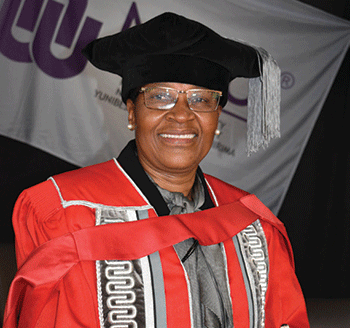
The NWU has awarded honorary doctorates to Justice Bess Nkabinde and Dr Geraldine Fraser-Moleketi.
Read moreDr Fraser-Moleketi was honoured for her lifelong work in society and in the South African political landscape. She received her degree on 19 November 2021.
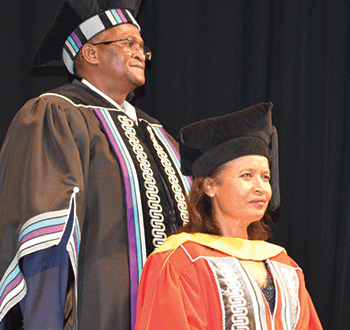
Justice Nkabinde, who received her honorary doctorate on 21 October 2021, has made an exceptional contribution to the legal profession and to social justice in South Africa.
MR BERT SORGDRAGER
CHAIRPERSON OF COUNCIL
