


Material risks and opportunities impacting value
Overview: our risk governance and management processes
On our journey to become greater and to empower our stakeholders on their path towards greatness too, it is inevitable that we would encounter risks – especially those associated with the Covid-19 pandemic. At the same time, we also come across opportunities to mitigate the risks and to grow and develop, pushing our boundaries to be greater today than yesterday.
At the NWU we use a strategic approach to risk and opportunity management. We identify and prioritise risks and opportunities that could influence our ability to implement the university’s strategy, and we adopt appropriate risk mitigation strategies and initiatives.
In doing so, we take into account the demands of and uncertainties in the external environment and we align our risk management processes with the King IV Report on Corporate Governance for South Africa. This approach ensures streamlined processes and procedures in accordance with the prescripts of the code.

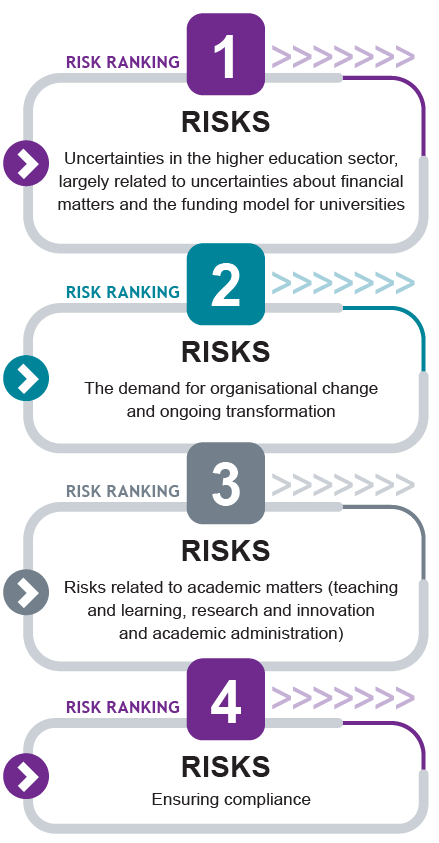

How we prioritise our risks and opportunities
The point of reference for prioritising, defining and assessing our risks is the NWU’s strategic goals.
For risk identification and risk definition, we use a template, coupled with a comprehensive process of implementing internal controls, setting future controls and agreeing on action plans to address the relevant risk reasons towards managing the risks to an acceptable level. All risks above appetite are prioritised and highlighted for focused management actions and reporting purposes.
For the past few years, we have been using a risk-cluster categorisation approach to identify the material risk clusters that are important for the university’s strategy, governance and management, performance and future planning.
These clusters are listed in the following table where we describe the risks related to each cluster and give a short summary of the associated mitigation strategies. (For more information, refer to our risk register.)


Related material matter providing the opportunity: Ensure financial sustainability and optimal performance with due consideration of macro-economic conditions and a drive towards digital transformation (2021 APP, Goal 6, Enabler 4 ).

Capitals affected: 
Risks that may put our financial stability under pressure include the financial and related impacts of Covid-19, the lack of clarity about the proposed fee regulation model, declining external financial support for postgraduate students, reservations about the sustainability of the government’s funding model for higher education, and rising student debt.
Mitigation measures included the internal development of a financial impact model that is updated constantly and accounts for all variables that might impact on the financial performance of the NWU. The mitigation strategies include focusing on fundraising and endowment initiatives to provide new and sustainable sources of income, building available reserves to cover one year of operational expenses, engaging in optimal relationships with funders and facilitating start-up capital through the Technology Transfer and Innovation Support Department.
Related material matter providing the opportunity: Govern, lead and manage in an agile, collaborative and integrated way towards an optimally digitised university environment (2021 APP, Enabler 1)..

Capitals affected: 
Risks in this cluster included insufficient levels of diversity (staff and students), vacuums created when key people leave, the lack of competitive salaries (academics), the perceived non-implementation of retention strategies, a change in stakeholder behaviour due to the Covid-19 pandemic, and uncertainties around the language plan implementation.
Mitigation measures included the implementation of a student recruitment and admission process** in line with the enrolment plan and diversity targets. Others were faculty language plans to implement the NWU Language Policy, a scarce-skill allowance, building employment equity targets into the performance agreements of managers, and developing and implementing retention strategies and clear position profiles for senior management indicating roles and responsibilities.
| ** | Despite these measures, the first-time enrolments for 2021 were more than 800 heads below target. |
Related material matters providing the opportunity: Promote excellent learning and teaching; also reposition the NWU to attain the size and shape required by market direction decisions (2021 APP, Goal 1).
Strengthen research and innovation with a strategic focus on impactful globalisation (2021 APP, Goal 2).

Capitals affected: 
Risks receiving attention in this cluster were a decline in research funding and research, inadequate infrastructure planning for teaching, an inadequate global engagement/internationalisation effort, and a gap in standards between basic and tertiary education.
Other risks were the university’s apparent unpreparedness for a blended learning environment, slow external processes for approval of qualifications/programmes, over and under enrolment and the perceived inability to meet marketplace expectations if graduates do not find employment quickly enough.
We also focused on risks such as the possibility that undergraduate and postgraduate academic offerings and related services may not be sufficiently responsive, and a decline in student throughout and student success.
Mitigation measures were developing the enrolment plan (2020-2025), including infrastructure planning in budget planning, and establishing a space management project.
Other measures included Council approving our Internationalisation Policy, commercialisation and investment opportunities being explored in international markets and efforts to target international alumni for donations. With regard to throughput, quality admission and placement tests were performed for admission to students’ second and third choice qualifications. Measuring tools to track student success were put in place.
Related material matter providing the opportunity: Govern, lead and manage in an agile, collaborative and integrated way towards an optimally digitised university environmentc(2021 APP, Enabler 1).
Strengthen research and innovation with a strategic focus on impactful globalisation (2021 APP, Goal 2).

Capitals affected: 
In this cluster, we focused on risks such as inadequacies in environmental management and information governance, fraudulent activities in some business processes, the inconsistent application of the Policy on Academic Integrity, non-compliance with health and safety laws and regulations, as well as with other statutory requirements, licences and legal requirements.
Mitigation strategies at play here were a focus on business continuity planning amid the Covid-19 situation, contingency planning for mission-critical processes such as registration and the implementation of our digital business strategy. Other measures included a compliance management process, compulsory training for all staff on the Protection of Personal Information Act (POPIA), positioning environmental management strategically, appointing departmental health and safety representatives, continually conducting occupational health and safety training and monitoring, and reviewing the Policy on Academic Integrity.
Related material matter providing the opportunity: Develop a clearly differentiated student value proposition with a focus on creating an inclusive environment aimed at developing students holistically through structured and unstructured co-curricular programmes that are relevant, desirable and meet students’ needs (2021 APP, Goal 4).
Promoting excellent learning and teaching and repositioning the NWU to attain the size and shape required by market direction decisions (2021 APP, Goal 1).

Capitals affected: 
In this cluster, the risks receiving attention were varying student experiences across campuses, the perception that the university is not living up to its promise of social justice, inadequate measures to create a welcoming student environment, inadequacies in student leadership skills, and challenges with student safety on and off-campus.
Mitigation strategies included training programmes on LGBTQ+ and other human rights matters, leadership training and continually measuring attitudes towards the student offering.
The NWU has a policy and rules on gatherings and demonstrations, supported by emergency contingency plans for student unrest.
Related material matter providing the opportunity: Establish a holistic and integrated university technology platform to provide a solid foundation for a digital future (2021 APP, Enabler 2).
Govern, lead and manage in an agile, collaborative and integrated way towards an optimally digitised university environment (2021 APP, Enabler 1).

Capitals affected: 
Worldwide, cyber security risk is regarded as the number one IT issue, necessitating more stringent cyber security measures at the NWU. The risk of a cyber-security attack is heightened in a period of digital transformation, which the NWU is currently undergoing.
Other risks receiving attention were inadequate IT provisioning for certain functions due to inadequate human resourcing of the IT department, and uncertainties about the digital business strategy, disaster-recovery planning and the possibility that core business systems could result in loss of students and income.
Mitigation measures included implementing a comprehensive cyber-incident and execution management system, developing a cyber-security strategy and deploying a security information and event management plan. A single centralised platform enables abnormalities in the NWU’s IT environment to be identified and escalated to the cyber-incident response team.
Related material matter providing the opportunity: Promote excellent learning and teaching, and reposition the NWU to attain the size and shape required by market-direction decisions (2021 APP, Goal 1).
Strengthen research and innovation with a strategic focus on impactful globalisation (2021 APP, Goal 2).

Capitals affected: 
Commercialisation risks included missing out on commercialisation opportunities, the failure of licensees or spin-out ventures to commercialise, resulting in wasted resources, and offering non-compliant short learning programmes that deflect income away from the NWU.
Mitigation measures included a proper governance and management environment to ensure accountability and optimal functioning of the commercialisation space. Provision has been made for an effective financial and operating model for commercialised entities. The management structure of the Centre for Continuous Education has been renewed to enable more commercialisation opportunities.
Related material matters providing the opportunity: Govern, lead and manage in an agile, collaborative and integrated way towards an optimally digitised university environment (APP, Enabler 1).
economic conditions and a drive towards digital transformation (APP, Enabler 4).

Capitals affected: 
An operational risk was inefficiencies in support functions, possibly leading to loss of income and potential growth, loss of staff and a negative impact on the reputation and ranking of the NWU. Other risks were absenteeism and loss of valuable staff owing to low staff morale.
Mitigation measures included a productivity and human resource allocation model, a process to reengineer business processes in preparation for the implementation of a new student information system, and a project to optimise space management and implement an electronic space-booking system. We also received a grant from the DHET to optimise our infrastructure development.
CAPITALS


Focus on the management of risks related to the Covid-19 situation
A number of risks pertinent to the mitigation of the short, medium and long-term risks pertaining to the Covid-19 pandemic continued to receive priority attention in 2021.
- A risk was added to the strategic risk register to account for possible inadequacies around a focused approach on the management of the pandemic as this might impact directly on the NWU’s governance and management. The risk impact was categorised as severe and the likelihood as certain, resulting in an inherent risk rating of 25.
- We considered all relevant controls that had been established. These included a financial impact model with the mitigation plans approved by Council, and the functioning of a Covid-19 response team whose mandate it was to advise the vice-chancellor and the university management committee.
These controls were rated as adequate, resulting in the residual risk rating coming down to 12, which is still above the NWU’s risk appetite.
- On completing the first level of assurance during the latter part of 2021, we concluded that the provisioning of an adequate governance and management environment to deal with matters related to Covid-19 in the short and medium term was regarded as fair assurance.
The challenge is to continue gleaning insights over the medium to longer term from the lessons learned about business continuity during the pandemic.
Using our opportunities
Our risk-cluster approach ensures focus in our ongoing risk management project. As part of this approach, we continually identify opportunities to adapt to our changing environment.
In accordance with the definition and refinement of goals and enablers in our APPs over time, the following threads remain visible as strategic opportunities that:
- continually safeguard the financial sustainability of the university;
- enable us to implement our new strategy, structure and operating model;
- promote excellence in teaching and learning and research and innovation;
- establish a clearly differentiated student value proposition;
- develop and retain excellent staff and create an equitable staff and student profile;
- enable the deployment of best-in-class information technology to support the core business; and
- provide an effective financial model, policies and structure for continuing education offerings and increased commercialisation opportunities
Steps taken in 2021
The focus on the monitoring of risk management continued in 2021 by means of bi-annual engagements with risk owners, followed by reports to management and governance structures. Council committees, in particular the Audit, Risk and Compliance Committee, have a defined role to fulfil in the ongoing monitoring of risk management. To this end, all Council committees, as well as Senate, continued to handle status reports on risk management on the relevant areas of interest at their May and October meetings.
The following graph indicates the status in 2021 of residual risks in the NWU strategic risk register, after consultation with risk owners:
| * | The number indicates the residual risk rating and the # indicates the number of risks at that particular rating on the NWU risk register. |
| 21 #0 |
22 #0 |
23 #0 |
24 #0 |
25 #0 |
| 16 #1 |
17 #0 |
18 #0 |
19 #0 |
20 #0 |
| 11 #0 |
12 #1 |
13 #3 |
14 #1 |
15 #0 |
| 6 #9 |
7 #5 |
8 #2 |
9 #0 |
10 #1 |
| 1 #1 |
2 #7 |
3 #6 |
4 #8 |
5 #0 |
Key to risk indicators
| Number of risks | Description | |
| High | 25 | The risk is potentially disastrous and will hinder the achievement of objectives and/or lead to the collapse of business and/or project. |
| Medium | 15 | The risk could have a serious impact on operations. A risk that can be managed with some additional resources, budget and maintenance effort. |
| Low | 10 | A risk that is unlikely to occur, but if it does occur it can be managed under normal operating conditions. |
| Minor | 4 | A risk event that holds no significant threat to the organisation, employees holders. |
Top 10 residual risks
| Rank | Risk | Description of risk | Residual risk |
| 1 | Cyber security | The risk exists that cyber security is not adequately addressed at the NWU, even though it is the number one IT issue worldwide. An attack on the NWU is likely. Digital transformation will increase the cyber security risk. | 20 |
| 2 | Business model | The lockdown forced a change in stakeholder behaviour and habits, as well as in the way universities function and people interact. In adapting to these changes, the university had to ensure adequate alignment of quality teaching and learning in relation to student access and success and fit-for-purpose workforce utilisation. | 16 |
| 3 | Funding | The government funding model is not sustainable and this is exacerbated by universities’ over-dependence on a single source of income (government subsidies and sustainability of NSFAS). The higher education sector also receives insufficient information about funding from the DHET. | 13 |
| 4 | Environmental management | The lack of focus and clarity in regard to the placement, functioning and monitoring of environmental management at the NWU poses a risk to sustainability and compliance. | 13 |
| 5 | Covid-19 Impact | An inadequate focus on the management of Covid-19 could impact directly on the NWU’s governance and management, and hamper the NWU’s sustainability on the short, medium and long term. | 12 |
| 6 | Fee regulation | Uncertainty around the proposed fee regulation model could affect the university’s sustainability. |
12 |
| 7 | Postgraduate students | Insufficient financial support to postgraduate students results in loss of student income and discontinuity from between undergraduate and postgraduate levels. Furthermore, the NWU’s postgraduate numbers are highly dependent on bursaries. | 12 |
| 8 | Digital Business Strategy | Digital transformation will have a severe impact on operational models, structures, people, processes and roles. | 12 |
| 9 | IT support and innovation | IT provisioning for certain administrative and academic functions is not optimal and there are indications that individual IT staff are overburdened due to inadequate human resources in IT. Furthermore, uncertainties are evident about the direction of the digital business strategy leading to delays in new system design and implementation. | 12 |
| 10 | Business processes | Inadequacies in the processes and systems that drive the core business could lead to loss of students and student income. | 10 |
The NWU Council, as the final decision-making body of the university, affirms that it is endowed with the responsibility and accountability for the effectiveness and efficiency of the risk-management process. It is continually apprised of developments by means of management and audit reports on the management and risk coverage processes; and had been provided sufficient assurance over the past year from all relevant assurance providers.
PROF MARLENE
VERHOEF
REGISTRAR DESIGNATED
WITH RISK RESPONSIBILITY
