


NWU value chain
Creating value to become greater than before
In 2021, our value-creation story was about empowering people and taking them along on a challenging but exciting journey to discover their strengths and harness their skills to become even greater than they were before.
We invested in our students because we believed in their potential (our input), we created value for them by exploring new possibilities and expanding our vision so that they could continue to grow and flourish (our activities), enabling them to become critical thinkers (our output) and eventually enter the labour market and society as value creators themselves (our outcome).
Throughout our value chain, we access, use and transform our capitals. For instance, as part of our input, we use our sources of income (financial capital), our skilled staff members (human capital), buildings and equipment (manufactured capital) and our academic programmes (intellectual capital) to create value for our students (human capital).
During our daily activities, for example our community engagement initiatives, we reach out to communities, thereby strengthening our social and relationship capital. Our research results (intellectual capital) are part of our output. As a result, we build good relationships with the outside world, thereby increasing our social and relationship capital.
We apply these results to find solutions to problems in society and in our country, thereby changing lives and creating a better future for people, which is part of our outcomes.
Our value chain also depends on the responsible use of our natural capital. In fact, all our capitals are based on the availability of natural resources. We need water, for instance, to sustain the lives of our staff and students (human capital) and land to build on (manufactured capital).
In the following discussion of our value chain, you will see how we draw on our various capitals as inputs and, through our activities, convert them to outputs and outcomes.
Input: Invest in people's potential
Our students
Our student body is an invaluable input into our value chain. The table below shows the composition and size of the student body in 2021 as compared to 2020:
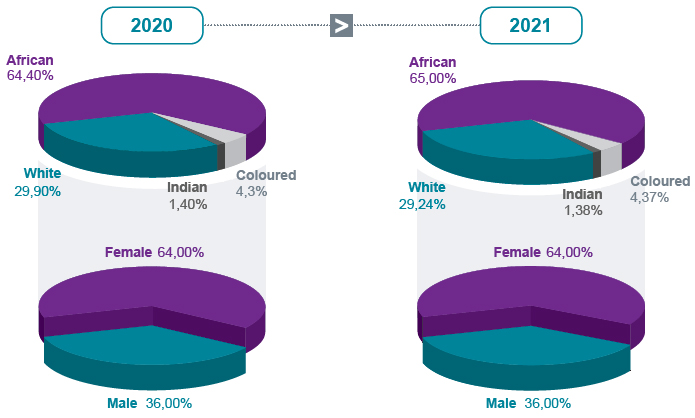
- Investing in our students
We follow a holistic and multidisciplinary approach towards caring for our students, offering them financial, psychosocial and academic support.
In 2021, the NWU's financial aid offices administered R2,69 billion in financial aid for students. The bulk (R2,19 billion) of this was government funding and a substantial amount (R238,8 million) came from the NWU's own funds. A limited amount of other external funding accounted for the rest.
In addition, we offer non-academic support such as psychosocial, health, sport and arts and cultural services aimed at developing our students holistically.
We also enable our students to achieve academic success through ongoing and focused academic support.
For more information about our academic support activities for students, turn to the section Increase student access and success.
Our staff
A significant input into our value chain is our staff complement.
The following table shows how our number of permanent academic staff compares with those of other South African higher education institutions (Please note that this is based on 2020 audited HEMIS data):
| Institution | Total |
| University of South Africa (Unisa) | 1 830 |
| North-West University | 1 632 |
|---|---|
| University of KwaZulu-Natal | 1 257 |
| University of Johannesburg | 1 309 |
| University of Cape Town (UCT) | 1 176 |
| University of Pretoria | 1 241 |
| University of the Witwatersrand (Wits) | 1 220 |
In 2021, we had a total of 4 140 permanent staff members, comprising 1 648 academics and 2 492 support employees.
Investing in our staff
The NWU has a comprehensive employee health and wellness programme that consists of psychosocial support, health awareness as well as organisational wellness interventions.
The NWU Wellness Unit provided various training opportunities focused on overall workplace well-being, supervisory training, stress management, resilience, gender-based violence, substance abuse and interpersonal relationships. The primary focus for 2021 was to create a nurturing environment for staff at the NWU to flourish within the workplace. This focus will continue in 2022.
We also have an annual academic promotions process, which is a recognition programme for our academics, underpinning the importance of building mutual value for both the academics and the NWU.
For 2021, there were 137 promotions approved which is 35 more than 2020. Although the percentage of black academics' share of promotions decreased by 0,6% overall from 2020 to 2021, the actual number of promotions increased in 2021 (46) when compared to 2020 (35).
Funding as input
- Research funding
NRF funding of R116,5 million was received in 2021 for research and innovation. The table below shows different funding pots from NRF:
| Grant programme | Number of awards | Total amount R'000 |
| Thuthuka | 21 | 1 865 960.86 |
| MRC funding | 8 | 2 647 967.14 |
| Other grant holder awards | 145 | 40 043 553.71 |
| Grant holder linked bursaries | 47 | 5 306 666.67 |
| Block grants | 4 | 1 590 000.00 |
| Freestanding bursaries | 346 | 44 159 174.64 |
| Freestanding postdoctoral bursaries | 11 | 2 491 667.00 |
| Freestanding postdoctoral funding | 10 | 490 000.00 |
| SKA student bursaries | 5 | 769 570.00 |
| SKA student equipment | 5 | 40 487.88 |
| SKA student travel grants | 1 | 70 000.00 |
| 2021 grant deposit | 17 000 000.00 |
Researchers in some of the NRF programmes were given the opportunity to move their 2021 funds to 2022 or any future year, which meant this funding was not lost to the researchers concerned.
In a significant funding change, the grant-holder linked and block-grant bursaries are being phased out. Students will only receive freestanding bursaries in future.
- Funding for technology transfer and innovation
Four grants of up to R500 000 each were made available from the pre-seed fund of the Technology Transfer and Innovation Support Department. This fund is for qualifying early-stage technology development projects and complements the seed fund programme of the Technology Innovation Agency (TIA). Seed funding from the Technology Innovation Agency (TIA) remains at a low level due to budget restrictions.
Many of the traditional sources of funding for technology transfer have either been frozen or reallocated since the outbreak of the pandemic. The Technology Transfer and Innovation Support team has therefore been concentrating on building new funding relationships. The university again made a special allocation of strategic funds available for key Covid-19-related projects.
More information about our efforts to increase research funding can be found under Six goals to realise our strategy.
- International funding
The table below shows the international funding each faculty received during 2021.The total amount, R28,8 million, was twice the amount received in the previous year.
| International funding for research | Actual as confirmed from faculties R'000 |
| Faculty of Economic and Management Sciences | 1 334 758 |
| Faculty of Education | 290 082 |
| Faculty of Humanities | 855 287 |
| Faculty of Engineering | 360 170 |
| Faculty of Health Sciences | 13 343 911 |
| Faculty of Natural and Agricultural Sciences | 12 623 339 |
| Grand total | 28 807 547 |

Power fluctuations sometimes associated with renewable energy resources could become a thing of the past through research underway at the NWU on new and better ways to store hydrogen.
The HySA Centre of Competence (CoC) at the NWU has embarked on various research projects to seek alternative hydrogen storage methods.
One of these uses Liquid Organic Hydrogen Carrier (LOHC) technology, where hydrogen is stored in the form of a heat transfer oil traded as Marlotherm-SH.
This oil is a mixture of dibenzyltoluene isomers, which have been used in many industrial applications such as an insulating oil in electrical transformers, and indirect heating of reactors, among others.
HySA believes that resolving fluctuations through better hydrogen storage methods could open up a host of possibilities for the application of renewable hydrogen. For example, it can be used as a feedstock in many industrial processes, including for steel manufacturing, floating glass production and margarine production through hydrogenation of vegetable oils.
Read more
Teaching-learning activities
In striving to keep our academic offering relevant, we are focusing on incorporating skills such as analytical thinking and innovation, active learning and learning strategies, complex problem-solving, critical thinking and analysis, and creativity, originality and initiative. These are the top five skills that will be in demand by 2025, according to our environmental scanning.
For more information, refer to the section on how we performed against our strategy and increased our intellectual capital.
- Greater student access and success
The NWU has a consistently high student retention rate. This indicates the effectiveness of the mechanisms our Centre for Teaching and Learning (CTL) uses to enable student access and success, especially among first-time entering students who, without sufficient support, may be most at risk of dropping out. These mechanisms include peer mentoring, reading development and supplemental instruction.
During the Covid-19 lockdown, these different forms of support to students were provided online and were also extended to our distance learning students.
- Promoting continuing education
The demand for online learning escalated over the pandemic period of 2020 and 2021. The 14 self-paced online short courses that our Unit for Continuing Education (UCE) has developed are popular and have so far attracted 298 participants in 20 intakes. The aim is to continue harnessing technology innovatively to provide short learning programmes that address the evolving needs of the labour market.
During 2021, both the UCE and NWU Business School presented short courses, reaching 4 567 learners participating in 162 short course events. These numbers are expected to increase over the next year as new tailormade short learning programmes are being developed.
- Improving graduate employability
Our Career Centre serves as a dependable link in producing well-rounded and resourceful graduates who are ready to enter the workforce, either as employees or as self-employed individuals.
In 2021, the centre hosted virtual career fairs using cutting-edge international technology that only three universities in the country were using. A total of 91 companies participated in these virtual career fairs (57 in 2018), and more than 3 000 students were reached. This was a significantly greater number than the 1 300 participants in 2020.
According to our records, 6 056 students attended our entrepreneurship and work-readiness training sessions in 2021, an increase of 43% on the 4 222 in the year before.
Confirming the Career Centre's success in supporting its graduates, it was runner-up in the Best Employer Liaison category of the South African Graduate Employers Association (SAGEA) Awards.
A breakdown of entrepreneurship and work-readiness training on each campus can be found under Career related support.
- Focusing on academic and professional development
The professional development of our academics is enormously important as excellent university teachers are fundamental to student success. Some of our professional development initiatives are the induction programme for new academics and the University Teaching Excellence Awards. Others are the annual Teaching and Learning Conference and activities related to the scholarship of teaching and learning.
Research activities
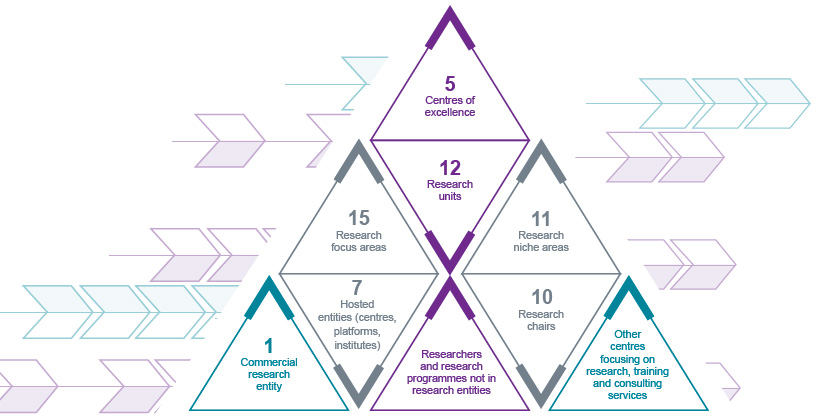
Our research activities were conducted predominantly in our 61 research entities, consisting of 10 research chairs, seven hosted entities, one commercial research unit and 43 NWU research entities.
These 43 entities comprised five centres of excellence, 12 research units, 15 research focus areas and 11 research niche areas. We also supported researchers and research programmes outside the research entities model.
Through regular external and internal evaluations of our research entities, we ensure that these continue to create maximum value for our stakeholders. Although the external evaluations were postponed in 2021, the internal evaluations went ahead, focusing on quality, productivity, sustainability and good management practices.
We took our PhD review online, resulting in a self evaluation report and improvement plan.
In striving to improve our research standing, the university provides focused support to researchers at all levels.
The Library and Information Services (LIS) took this further in February 2021, by appointing a director responsible for research and open scholarship. One of the new director's first priorities was to organise group and one-on-one sessions to improve the research skills of both postgraduate students and early-career researchers.
The current NWU research landscape is shown in the following figure:
Output: Becoming critical thinkers
Teaching and learning output
We are proud of our student success rates, which can be ascribed to the high level of teaching excellence, and academic and student support available at the university.
Our contact success rate has stayed over 85% for the past three years. The contact undergraduate degree graduation duration factor stood at 1,09 in 2021. This is lower than in 2020, indicating that most students complete their degrees in the minimum time. The calculation of the graduation duration factor takes the duration that a student studies (in years), divided by the minimum duration of the qualification. Thus, the closer this indicator is to 1, the better.
In the case of the first-time entrants, the dropout rate for contact degrees decreased from 11,48% in 2020 to 8,96% in 2021,and remains low in comparison to sector norms.
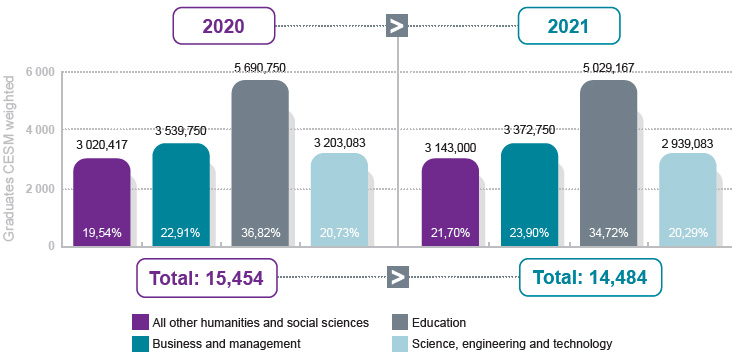
The following graph shows the number of graduates per field of study for 2020 and 2021:
The following table shows how our number of graduates compare with those of other South African higher education institutions (based on 2020 audited HEMIS data):
| Institution | Total |
| University of South Africa | 64 423 |
| North-West University | 15 454 |
|---|---|
| Tshwane University of Technology | 14 897 |
| University of Pretoria | 12 852 |
| University of Johannesburg | 13 035 |


Two University Teaching Excellence awards were awarded. They went to Ms Veruschka Pelser-Carstens (left) from the Faculty of Economic Management and Science and Dr Sune van der Linde (right) from the Faculty of Natural and Agricultural Sciences.

Teaching and learning awards
The NWU Excellence Awards are held annually to acknowledge and celebrate the exceptional output of our academic staff in teaching and learning practices and innovation.
Research output
The following table shows the quality and quantity of research at the NWU:
| 2019 | 2020 | |
| Journal articles | 1 233,18 | 1 264,32 |
| Conference proceedings | 118,75 | 38,84 |
| Books and chapters | 189,22 | 233,43 |
| Total article equivalents published | 1 541,1503 | 1 536,59 |
| Master's degrees conferred | 798 | 722 |
| Research master's | 574,872 | 521,605 |
| Research master's weighted | 574,872 | 521,605 |
| Doctoral degrees conferred | 314 | 251 |
| Doctoral degrees weighted | 942 | 753 |
| Total weighted research output | 3 058,0223 | 2 811,1914 |
| Postdoctoral fellows | 231 | 215 |
| Publication units per permanent academic staff member | 0,98 | 0,93 |
Read more about our research output in the section How we create value against our strategy.
- NWU Excellence Awards
We celebrate our researchers' hard work and exceptional output at the annual NWU Excellence Awards, held towards the end of each academic year.
As with the 2020 celebration, the 2021 awards were held virtually owing to the pandemic. We presented 43 awards in 2021, consisting of 34 awards for NRF ratings, eight Research Excellence Awards and one International Scholar Award.
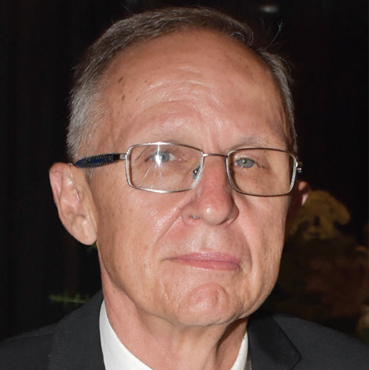

Prof Marius Nel from the Faculty of Theology (left) was named the most productive senior researcher of 2020, while Dr Jess Auerbach from the Faculty of Humanities (right) was named the most productive emerging researcher.

Outcomes: Enter society as great value creators
The first links in our value chain are our inputs and activities, as discussed in previous sections of this report. The next stage of the value chain consists of our outcomes, which are intended to create longer-term value.
This future focus means that sustainability is an integral element of our outcomes. After we have taken care of immediate and medium-term needs, there must be sufficient capitals left to use for future value creation.
Financial stability is a good example of an outcome that supports our sustainability. When the NWU is financially stable, we are in a position to generate other outcomes, such as delivering skilled graduates to enhance the knowledge economy of the country. Sustainable financial stability is a factor of our external environment and risk cluster 1, as it is influenced by uncertainties in the higher education environment.
Our research output is also an outcome. It strengthens our reputation (another outcome) so that we can attract highquality scientists, further building our human capital and ensuring our future sustainability. This leads to another outcome in the form of solutions to real-life problems that leverage our research and innovation results.
In addition, the third leg of our core business, namely community engagement, creates outcomes by empowering people to become greater and improve their lives in a sustainable way.
DR BISMARK TYOBEKA
CHAIRPERSON OF SENATE
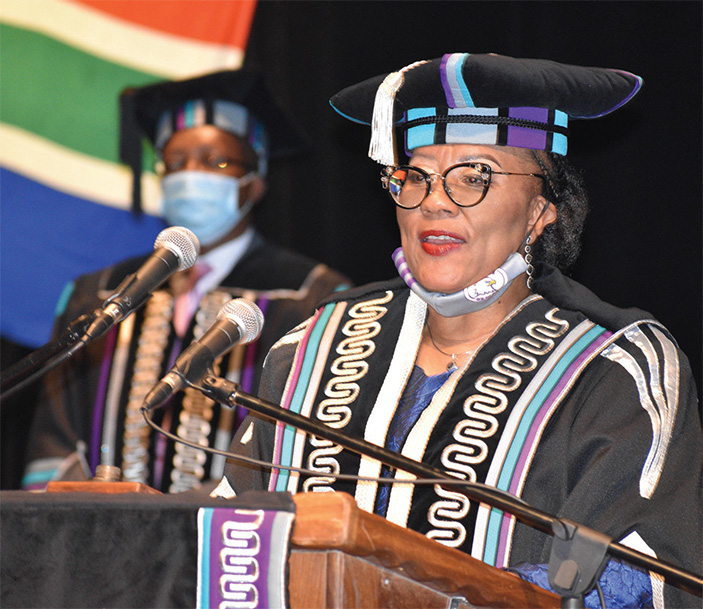
In April, May and June 2021, no fewer than 13 119 graduates and diplomates “walked” the virtual stage during their online graduation ceremonies. Of these, 136 students received PhD degrees. NWU chancellor Dr Anna Mokgokong officiated.
NWU Chancellor.
