


MATERIAL RISKS AND OPPORTUNITIES IMPACTING VALUE
The better governed and more sustainable the NWU is, the greater our ability to attain constantly improving results. The depth and quality of risk management is a decisive factor in this.
We identify and prioritise risks and opportunities that could influence our ability to implement the university's strategy, and then adopt appropriate strategies and initiatives to mitigate the risks.
In April 2024, we focused on our risk appetite and risk tolerance levels in relation to each goal and subgoal in the 2024 Annual Performance Plan (APP).
Risk appetite is the amount of risk we are willing to accept in the pursuit of our strategy and business objectives. Risk tolerance is the amount of risk that is acceptable in the context of achieving a particular goal or objective.
We also reviewed the risks linked to the portfolio of each member of the UMC. Another priority was updating the NWU control library, which documents all the controls we use to manage and mitigate risks. An up-to-date control library is critical because of the constant changes in higher education regulatory requirements, industry standards and organisational structures.
The APP 2024 contains some important commitments about risk management at the NWU. These include taking steps to enhance the maturity of our risk management approach and ensuring that risk appetite and risk tolerance are top of mind when implementing the university's new strategy, Taking the NWU forward – 2024 and beyond.
Our risk management methodology includes the following stages:
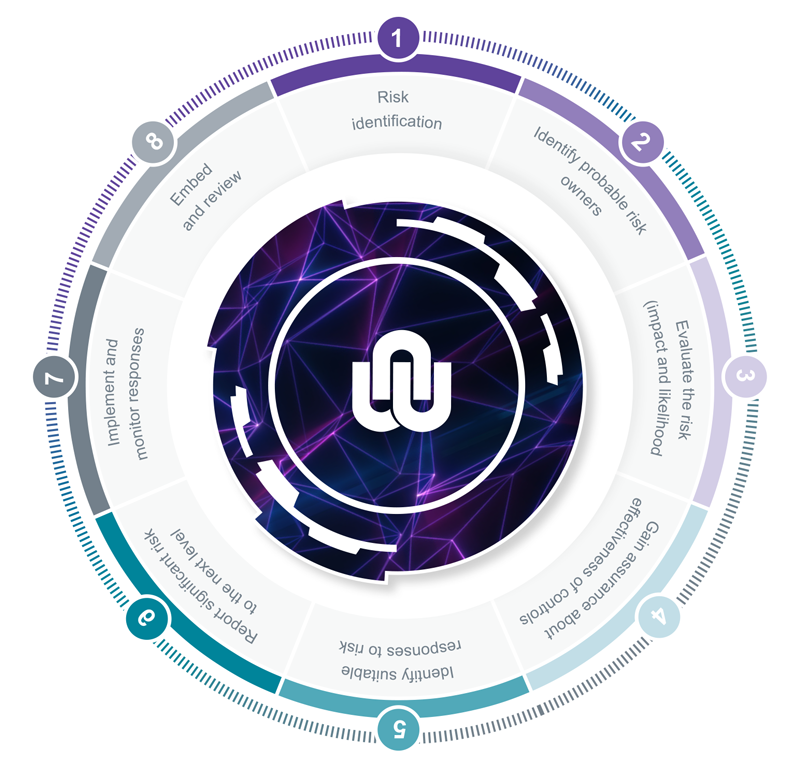
We use a template to identify, define and manage risks. Based on this, we implement internal controls, set future controls and agree on action plans to manage the risks to an acceptable level.
Apart from identifying strategic risks affecting the NWU APP, we also capture risks at faculty and departmental levels. In this way, we make sure that risk management is part of all management levels and processes at the NWU.
Each May and October, we table risk reports at all Council committee meetings so that the committees can identify possible emerging risks for management to explore further.
In November 2024, the NWU Council approved the Strategic Risk Register and top risks of the NWU. Risks are rated on a scale from 1 to 10, and all risks with a rating of 8 and above are included in the register.
While continually identifying and updating our risks, we also do the same for our opportunities.
Over time, we have consistently focused on strategic opportunities that enable us to:
- safeguard the financial sustainability of the university;
- implement our strategy, structure and operating model;
- promote excellence in teaching and learning and research and innovation;
- establish a clearly differentiated student value proposition;
- develop and retain excellent staff and create an equitable staff and student profile;
- enable the deployment of best-in-class information technology to support the core business; and
- provide an effective financial model, policies and structure for continuing education offerings and increased commercialisation opportunities.
The following tables describe the top risks that affected our ability to create value, and how we addressed them.
Develop and implement the Digital Business Strategy to create a competitive advantage for the NWU, ultimately unlocking a revenue stream.
(2024 APP, Goal 6) 
Cyber security is the number one IT issue worldwide and is not adequately addressed at the NWU. An attack on the NWU is likely. Digital transformation will increase the cyber security risk.
The NWU has a comprehensive cyber-incident and execution management system, cyber-security strategy and security information and event management plan. We use a single centralised platform to identify abnormalities in the NWU's IT environment and escalate these to the cyber-incident response team.
Govern, lead and manage in an agile, collaborative and integrated way towards an optimally digitised university environment.
(2024 APP, Enabler 1) 
Fraudulent activities could be prevalent in some business process environments and could impact negatively on the reputation of the NWU.
Our financial system, KFS, detects and prevents irregular transactions involving NWU staff. We run anti-fraud awareness campaigns and promote ethical business conduct by applying the NWU Policy and Rules on Conflict of Interest. Staff are required to declare any potential conflict of interest, as well as any gifts offered to them. We also have an approved policy on the Prevention of Bribery, Corruption and Fraud and on Whistleblowing.
In dealing with disciplinary cases involving academic dishonesty, the NWU has a zero-tolerance approach. We use a secure process for drafting, printing and transporting examination papers.
To create a competitive advantage for the university by advancing and implementing the Digital Business Strategy, ultimately unlocking alternative revenue streams.
(2024 APP, Goal 6)
There are uncertainties around the impact of the Digital Business Strategy. Digital transformation may have significant impact on operational models, structures, people, processes and roles.
Our focus in 2024 was on preparing the NWU to leverage the gains from the move towards the digital future and address the associated risks.
Strategic digital initiatives include the Student Information System (SIS), and Work Integrated Service Learning (WISL) system projects, as well as e-assessment and proctoring platforms/software and further development of the NWU learning management system.
To ensure the NWU is fit-for-purpose and manages its digital transformation to meet the demands of the 4IR, we are rolling out stable, scalable, hybrid, manageable and responsive infrastructure. Data centre resources will be as readily available as cloud services and standardised shared services will ensure business agility. We are also strengthening the security our digital environment and building the technology ecosystem that integrates students, partners, employees and the internet of things (IoT).
Govern, lead and manage in an agile, collaborative and integrated way towards an optimally digitised university environment.
(2024 APP, Enabler 1)
The lack of a sufficiently focused approach to data and information governance implementation could hamper the NWU's operations and create compliance risks.
The NWU is focusing on business continuity planning, contingency planning for mission-critical processes and the implementation of our Digital Business Strategy. We also have a resilient compliance management process, conduct compulsory training for all staff on the Protection of Personal Information Act (POPIA) and are reviewing the Policy on Academic Integrity.
In addition, we are appointing an information governance coordinator and have commissioned Tata Consultancy Services to develop an institutional data and analytics strategy and operating model. A three-year roadmap has been suggested to implement the various recommendations.
Attract, develop and retain excellent staff by creating an environment that is diverse, equitable and inclusive.
(2024 APP, Goal 5) 
Line managers' failure to adequately manage sick leave may lead to a failure to detect potential risk claims and loss of productivity.
The NWU has made it compulsory for line managers to conduct return-to-work conversations after each absence for sick leave in certain circumstances. Monthly reports are shared with line managers so that they can manage sick leave. We also hold monthly meetings with financial services and employee benefits company Assegai Strategic Investment (ASI) to ensure that potential causes are addressed.
Ensure financial sustainability and optimal performance with due consideration of macro-economic conditions.
(2024 APP, Enabler 4) 
The government funding model is not sustainable and there is a lack of clarity on the processes the DHET has been using to regulate fees since 2016. The sector is overdependent on government subsidies and there is uncertainty about the sustainability of NSFAS.
We constantly update our financial impact model to include all variables that might impact on our financial performance. The NWU is also intensifying fundraising and endowment initiatives, ensuring we have reserves to cover one year's operational expenses, building optimal relationships with funders and facilitating the raising of start-up capital for companies with potential to earn third-stream income.
Strengthen research and innovation with a strategic focus on impactful globalisation.
(2024 APP, Goal 2) 
High numbers of postgraduate enrolments reflect well on the university's national and global standing. A constraint is poor financial support to postgraduate students, who are largely dependent on bursaries.
Our postgraduate funding model provides merit bursaries to qualifying students who received NSFAS funding during their undergraduate studies. Strategic funds are made available to a limited number of potential candidates. A special fund is being established to provide further funding.

Strengthen research and innovation with a strategic focus on impactful globalisation.
(2024 APP, Goal 2)
Poor-quality research products could lead to a decline in or inadequate resources for research and research chairs, potentially affecting the university’s standing globally and impeding our ability to attract high-calibre international research collaborations.
Our budgetary process focuses on sustaining and enhancing the research function, and we use control sheets to monitor the spending of research funds. We have processes to detect and manage academic misconduct, conduct ongoing compliance audits on the Academic Integrity Policy and hold webinars and awareness campaigns on academic integrity.
The NWU uses the SCImago journal ranking tool to independently determine research quality before any research paper is sent for publication.
Promote excellent student-centric learning and teaching and conduct research and innovation with a strategic focus.
(2024 APP, Goal 1
and 2) 
Inconsistently applying the NWU Policy on Academic Integrity could have a negative impact on the reputation of the university. This could result in penalties, qualifications being revoked and loss of income from subsidised publications.
In November 2024, Council reviewed and approved the Policy and Rules on Academic Integrity, which has clear rules for interpreting and managing cases of alleged misconduct. In the student environment, academic integrity matters are dealt with collaboratively by the campus Writing Laboratories and the Student Judicial Office.
We are refining our capabilities to execute technical investigations, and have implemented in-house applications that focus on the style and register of writing. The deputy vice-chancellor: Research and Innovation hosts webinars on academic integrity in the research environment, and faculties also run awareness campaigns for students.
Integrate and align community engagement with teaching-learning and research to develop a culture of active citizenship.
(2024 APP, Goal 3) 
An insufficiently focused approach to environmental management could hamper the NWU's operations and expose the NWU to compliance risks.
Environmental sustainability is entrenched in all our activities and we began implementing mitigating actions in 2022 with an environmental gap analysis and action plan. More recently, we have appointed an internal and external safety, health and environment (SHE) projects team and introduced a SHE system for benchmarking, development and implementation. A SHE system facilitates the management of SHE requirements and enables faculties and departments to manage and monitor their SHE risks/impacts.
Attract, develop and retain excellent staff by creating an environment that is diverse, equitable and inclusive.
(2024 APP, Goal 5)
Perceived lack of competitive salaries in the academic and support environment might lead to an exodus of talent, and consequently possible loss of accreditation in certain areas with scarce skills.
We address remuneration disparities by strictly applying individual remuneration review guidelines. Clear position profiles for senior management describe roles and responsibilities. We also have guidelines for private work, and implement scarce skills allowances for academics and IT staff. Staff received a differentiated cost of living adjustment (COLA), with employees in lower job grades receiving a higher adjustment. We have finalised our succession planning guidelines, starting with mission-critical and UMC positions and then cascading succession planning to other levels, focusing on scarce positions and scarce expertise.
To create a competitive advantage for the university by advancing and implementing the DBS, ultimately unlocking alternative revenue streams.
(2024 APP, Goal 6
and Enabler 1)
Lack of regular testing on the disaster recovery plan and business continuity management processes could hamper the NWU's operations and lead to financial losses and reputational damage.
We conduct business continuity planning and contingency planning for key processes such as registration. Council has approved the Business Continuity Policy and we have removed redundancies in our business processes. The NWU implements the UMC Rules for Business Continuity Management and Administration, enabling risk integration and incorporating business continuity management into day-to-day organisational and business decision-making. Furthermore, the Cybersecurity Strategy has been approved and targets set to improve the NWU's cybersecurity capabilities.
Strengthen research and innovation with a strategic focus on impactful globalisation.
(2024 APP, Goal 4 and 5)

Inadequate levels of diversity in staff and student environment could undermine the university strategy.
Employment equity targets are part of the performance agreements of Senior Management Committee members. Through our Employment Equity Policy, we create equal opportunities for all employees and remove barriers to performance. We have finalised our approach to succession planning and introduced a control mechanism to monitor and approve non-designated appointments.
Strengthen research and innovation with a strategic focus on impactful globalisation.
(2024 APP, Across all goals and enablers)
The NWU academic project could be in jeopardy if support functions are ineffective or inefficient, possibly leading to loss of income and potential growth, loss of staff and negative impact on the reputation of the NWU.


Our business continuity and contingency plans focus on key student administration processes such as registration.
Each section in the student administration lifecycle environment understands the university policies relevant to their environments and the structure and lines of operation on the campuses. The job descriptions of support staff are up to date.
We ensure there is clarity on roles and responsibilities. A quality manual has been approved and implemented, and regular scheduled meetings are held between the deputy registrar and executive deans. Staff and students are encouraged to exemplify the NWU values, and we use the NWU Organisational Citizenship Recognition Awards to honour those who do so.
Ensure financial sustainability and optimal performance with due consideration of macro-economic conditions.
(2024 APP, Enabler 4)
The risks include loss of opportunity income and subsidies, loss of students and staff and compromised teaching quality due to limited and inadequate infrastructure planning, as well as limits on the availability of facilities and infrastructure.
The Institutional Budget Committee makes provision for infrastructure planning in budgeting planning. We have a space management project for teaching and non-teaching spaces across the university, and use an Integrated Work Management System (IWMS) to manage facilities-related processes.
All of these plans and processes take the NWU student enrolment plan (2020-2025) into account, ensuring facilities are matched with student numbers.
| Risk
number |
Risk name |
Initial risk rating |
Previous risk rating |
Current risk rating |
| 230 | Data and Information Governance | 12 | 16 | 16 |
| 309 | The implications and demand for digital transformation on the NWU's business after COVID-19 | 16 | 16 | 16 |
| 313 | Loss of productivity due to excessive use of sick leave | 16 | 16 | 16 |
| 232 | Funding and fee regulation | 12 | 12 | 12 |
| 3 | Postgraduate students | 7 | 12 | 12 |
| 9 | Research Quality | 12 | 12 | 12 |
| 17 | Academic Integrity | 4 | 10 | 10 |
| 22 | Protecting the brand and reputation of the NWU | 3 | 9 | 9 |
| 40 | Environmental Management | 12 | 16 | 9 |
| 41 | Staff –perceived lack of competitive salaries | 6 | 9 | 9 |
| * | The number in the top left-hand corner of each block indicates the residual risk rating and the # indicates the number of risks at that rating on the NWU risk register. |
| Name | Value | Description | Colour |
| Minor | 4 | A risk event that holds no significant threat to the organisation, employees or other stakeholders. | Green |
| Low | 10 | A risk that is unlikely to occur, but if it does occur can be managed under normal operating conditions. | Yellow |
| Medium | 15 | The risk could have a serious impact on operations. It can be managed with some additional resources, budget and maintenance effort. | Orange |
| High | 25 | The risk is potentially disastrous and will hinder the achievement of objectives and/or lead to the collapse of business and/or projects. | Red |
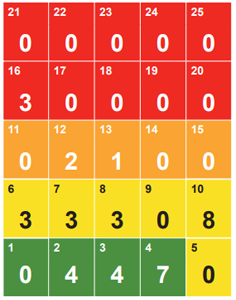
We have embedded risk management as a strategic mindset across the institution. Priorities are to continue refining our understanding and management of risk and intensify our efforts to make risk management part of the day-to-day operations of the NWU.
The NWU is busy migrating to a new enterprise risk management (ERM) system that will strengthen assurance provisioning by allowing greater process integration.
Risk reporting takes place at various levels: at the UMC, the Audit, Risk and Compliance Committee, Combined Assurance Forum, Faculty Management Committees and the Council committee meetings in May and October.
The reports submitted to Council committees in 2024 focused on integrating risk appetite and risk tolerance into the 2024 APP. Reporting also emphasised key elements of the Strategic Risk Register, and linked each risk to the expertise and oversight of each committee. The Council committees are required to identify emerging risks on an ongoing basis.
Towards the end of 2024, Deloitte performed an audit of the risk management processes at the NWU. The next table shows the scope of this audit.
| Scope | Activity reviewed |
| Risk governance |
|
| Risk infrastructure and oversight |
|
| Risk ownership |
|
| Risk monitoring |
|
| Compliance obligations |
|
The outcome of the audit was received in December 2024. Management comments on the findings and way forward will be provided in 2025.
PROF MARLENE VERHOEF

 INTEGRATED ANNUAL REPORT | 2024