Our intellectual capital consists of the knowledge
resources linked to our
core business activities. We use these knowledge resources to create more
knowledge and to develop and implement programmes, policies, strategies and
procedures to support our business operations for the benefit of
stakeholders.
Stakeholders who will benefit from our
intellectual capital
When we increase our intellectual capital through our research or teaching
and community engagement activities, many stakeholders benefit.
These stakeholders include our staff, current and prospective students and
their parents, the DHET, communities, donors, alumni, employers, business
and industry and professional bodies.
Material matters (goals or enablers)
involved
Material matters are teaching and learning, research, community development,
ability to govern, lead and manage, and information and communication
technology.
There are risks related to academic matters, non-compliance with the
standards and regulations of professional bodies, organisational change,
ongoing transformation (such as decolonising the curriculum) and IT,
university systems and commercialisation of our innovation and research
results.
Read more about the mitigation of these risks
here
Material matter:
Teaching and learning
An ongoing concern is that students struggle with selfdirected
learning, particularly online learning, underlining
the importance of in-person support for at-risk students.
Where possible, we integrate self-directed learning skills
into our academic literacy training.
At the NWU, all first-year students take an academic
literacy test and, depending on the results, may need to
register for academic literacy modules such as academic
writing, reading, computer and information literacy and
study skills.
We offer extensive, value-adding academic support to
students, including extended academic programmes,
the University Preparatory Programme (UnivPrep),
Supplemental Instruction (SI) and tutorial programmes.
These programmes deliver good results:
- The overall student success rate for extended
academic programmes, where students are given more
time to complete their studies, is approximately 90%.
- Each year, more than 50% of successful UnivPrep
participants become eligible to apply for formal
studies in the faculties of Humanities, Theology and
Economics and Management Sciences. UnivPrep
is for prospective students who do not meet the
admission requirements for specific formal degrees.
- In 2024, a total of 5 564 students in 75 at-risk
modules received SI assistance from 91 SI leaders.
Notably, 86% of attendees found the SI sessions
valuable and would recommend them to peers,
while 80% of the 84 lecturers involved with SI were
satisfied with its implementation. The remaining
20% suggested making attendance mandatory and
expanding SI support to additional modules.
- During the first semester, 131 tutors were appointed
in 120 priority modules identified for additional tutorial
assistance owing to the complexity of content and
high rates of student discontinuation. In the second
semester, 153 tutors were appointed in 127 modules.
A total of 3 397 tutorials were held for the year,
reaching 19 740 students. Lecturer satisfaction was
high: 54% were very satisfied with the programme
and 34% satisfied. They reported improved pass rates
and greater confidence among students in navigating
their coursework.
- Altogether 91 peer mentors were appointed during
2024, each of whom was expected to do peermentoring
duties for 23 hours per month. Their role
is to help first-year students integrate into the NWU
community, develop essential social and academic
skills, and foster an inclusive environment that
reduces dropout rates and supports diverse student
groups.
- A total of 560 academic advising sessions were held
from January to June 2024, and we made progress
in drafting an Academic Advising Guiding Framework
for the NWU, proposing many opportunities or training
and development.
The First Year Experience (FYE) programme recorded
17 095 in-person contacts with first-time entering students
in 2024. In addition, the First Year Navigator (FYN)
platform on the NWU's learning management system
received 6 968 views by 4 755 users. The goal of the FYE initiative is
to
improve and support student success
by familiarising students with the higher education
environment and the available academic development and
support services.
Our contact student success rate was 85,8% for
undergraduate and postgraduate students combined.
Our distance student success rate (also combining
undergraduate and postgraduate students) was 93,67%.
How much value we created, compared to previous years:
| Academic
performance |
2022
|
2023
|
2024
|
| Contact student success rate
(undergraduate and postgraduate students combined) |
84,7% |
84,14% |
85,8% |
| Undergraduate degree graduation duration
factor |
1,08 |
1,11 |
1,12 |
| Graduation rate* |
25,4% |
22,43% |
23,54% |
* Where the education offering of an
institution consists mostly, but not exclusively, of three-year
programmes, it is expected that
approximately a third of any cohort should graduate.
How much value we created, compared to our targets:
| Academic
performance |
Target
|
Definition |
Actual
|
| Contact student success rate
(undergraduate and postgraduate students combined) |
87%
|
Based on HEMIS data.
Completed FTEs divided by enrolled FTEs on a module level |
85,8% |
| Undergraduate degree graduation
duration factor |
1,2 |
Based on HEMIS data. The time (in
years) it takes a student to graduate divided by the minimum time to
complete the qualificatio |
1,12 |
- There has been an increase in team-teaching, where academics use the
technology and equipment in lecture venues to reach students across
campuses. This is part of our commitment to ensure all students have
access to equivalent resources and benefit from comparable high-quality
teaching and learning. The faculties of Economic and Management Sciences
and Humanities participated in several external programme reviews in
2024. Four programmes were commended by external evaluation panels,
namely the BCom in International Trade, the BCom Honours in Economics
with Risk Management, the BA in Public Governance with Public
Administration, and the BA Honours in History. Other programmes that
underwent external evaluation included the BMus degree (music); BA
Honours in English (Mahikeng); BA Honours in English with Language and
Literature (Potchefstroom); BA Honours in English with Language and
Linguistics (Vanderbijlpark) and BA in Public Governance with Politics
and Public Administration.
- In April, a comprehensive external thematic review was conducted of all
Understanding the World (UTW) modules. In June, a post-external
programme review of the Diploma in Coaching Science in the Faculty of
Health Sciences was successfully concluded.
- Several internal programme evaluations were either initiated or carried
over from 2023 for completion in 2024. More information on these
evaluations can be found in the section on Governance matters.
- We began preparing for various accreditation visits in 2025. More
information on these visits is available in the section on Governance matters. The
digital classroom prototype initiative is ready for the next steps,
which involve procuring the hardware, software and licences, as well as
conducting testing. We began rolling out the Work Integrated and Service
Learning (WISL) system, after piloting it for education and nursing
students.
- The NWU micro-credentials framework was approved in 2024, preparing for
just-in-time development for the world of work and lifelong learning.
More information on the NWU's approach to microcredentials is available
in the section on Governance structures of
the NWU of the DHET report.
How much value we created, compared to previous years:
|
Graduates
|
2022
|
2023
|
2024
|
| Overall |
13 735
|
12 358
|
13 563 |
| Contact |
10 323
|
10 175
|
10 757 |
| Distance |
3 412 |
2 183 |
2 806 |
How much value we created, compared to our targets:
| Output |
Target
|
Definition |
Actual |
| Graduates |
14 377 |
Based on HEMIS data; number of graduates in the
reporting year |
13 563 |
It is vital to ensure all our offerings are nationally and internationally
comparable, appropriately designed and incorporate accessible ICTs,
including AI and machine learning. (Refer to the below section Future outlook, for more
information on our approach to AI.)
We continue to further decolonise the curriculum, include African-appropriate
sections of our offerings and find opportunities to promote multilingualism
in teaching and learning.
AI has enormous potential in higher education and also poses substantial
risks. Early in 2024, we established an AI Steering Committee, which
developed a Framework Policy for AI at the NWU, a statement of intent on AI
and Guidelines for the Ethical and Responsible Use of AI. We are now
focusing on educating and informing staff and students about the responsible
use of AI.
We are preparing to introduce a new learning management system (LMS).
Implementation will begin in 2025 and in 2026, lecturers should be ready to
use the new LMS for first-year modules. By the end of 2027, all modules
should be on the new system.
To ensure that the NWU PQM remains agile and relevant, we will continue
recalibrating the PQM review project.
Material matter:
Research
When our researchers and innovators find affordable and workable solutions to
societal problems, they increase our
intellectual capital and create value for us and our stakeholders.
The number of NRF-rated researchers rose from 298 in 2022 to 323 in 2023 and
327 in 2024
The following table shows the numbers of researchers in the different rating
categories:
| NRF |
2022
|
2023
|
2024
|
| A |
1 |
1 |
1 |
| B |
36 |
36 |
35 |
| C |
196 |
218 |
220
|
| P |
2 |
1 |
1 |
| Y |
63 |
67 |
70 |
| Total |
298 |
323 |
327
|
A – Leading international
scholars
B – Internationally acclaimed
researchers
C – Established researchers
P – Prestigious awards
Y – Promising young researchers
How much value we created, compared to previous years:
| Research |
2021
|
2022
|
2023*
|
| Publications per academic staff member
|
0,99 |
1,02 |
1,04 |
| Weighted research output |
2 958,062 |
2864,276 |
3133,323 |
| *Please note that there is a
two-year lag with regards the research output.
|
|
|
|
Increase our global standing and visibility
We have partnerships with prestigious institutions such as the Corporación
Universidad de la Costa in Colombia, the
University of Leeds in the United Kingdom and the University of Hong Kong in
Asia, among others. Through our research
collaborations with these and other partners, we co-chair collaborative
research and innovation programmes and offer
collaborative degrees, skills development opportunities and conduct
international student recruitment and exchange.
We are part of multilateral international partnerships such as the Southern
African Regional Universities Association
(SARUA) and the Southern African-Nordic Centre (SANORD).
We continue to be an active partner in research collaborations within the
Brazil, Russia, India, China, South Africa
(BRICS) bloc, and have knowledge-sharing and skills-sharing agreements with
several BRICS universities.
The Open Access Colloquium held during International Open Access Week
provided a platform for robust discussions on
the future of open access publishing.
Create value through innovation and technology
Commercialisation revenues were lower in 2024 than in 2023, but the number of
new licences increased, presenting the
prospect of future royalty income.
The Technology Transfer and Innovation Support (TTIS) office facilitated the
NWU's relationships with industry partners,
investors, government agencies and other institutions. The NWU The NWU
hosted World IP 2024 in the North West
Province at the request of the Companies and Intellectual Property
Commission and its partners, the National IP
Management Office, Small Enterprise Development Agency, Technology
Innovation Agency and the Department of
Trade, Industry and Competition.
We also participated in the 2024 Science Forum South Africa in December at
the CSIR International Convention Centre,
Pretoria. The Department of Science and Innovation (DSI) and the Science
Diplomacy Capital for Africa (SDCfA) co-hosted the event.
Some NWU highlights at the 2024 Science Forum were
NWU-developed games such as Prof Petro Erasmus's
Whartels® mathsgame for children, Prof Jaco Fouche's
Commercium, introducing players to business and
accounting transactions, and a range of educational
games developed by Prof Byron Bunt and Dr Lance Bunt.
Also exhibited were the latest sustainable hydrogen
energy solutions of the HySA Infrastructure Centre of
Competence, located at the NWU, the Novel Surfactants
Project of Dr Frans Smit from the Chemical Resource
Beneficiation research group, and the 1Nngwe Project,
led by Prof Chris Vorster, from the Centre for Human
Metabolomics, highlighting developments to improve
healthcare and diagnostics of rare diseases in infants.
More information on these and other NWU
innovations at the Science Forum.
Click here.
Challenges with research output
The three most complex research output challenges
we face are funding limitations, competition among
universities for a limited pool of existing researchers and,
despite our determined efforts to encourage all academics
in all faculties to be research-active, the fact that a number
of academics have yet to engage with research.
In terms of funding, our approach is to discover and tap
into new sources of funding, maintain good relationships
with funders and ensure that our sophisticated research
infrastructure is well-maintained.
We updated the Innovation Fellowship programme, which
was piloted in the previous year to encourage researchers
to engage in innovation. In addition, we continued with the
new IP incentive scheme to acknowledge the effort our
inventors expend on the patent prosecution process.
Future outlook
Having strengthened the research ecosystem in 2024, we
aim to build on these successes and continue supporting
our researchers to deliver results with impact.
We are diligently striving to enlarge our pool of productive
researchers and innovators across disciplines, and look
forward to growth in the number of IP disclosures from the
humanities and social sciences.
Material matter:
Govern, lead and manage
Creating optimal value through good governance and
management is premised on our governance structures,
approach to ethics, strategy, values, success model and
APP.
These are part of our intellectual capital, along with the
systems, processes, procedures and policies that support
governance and management.
For more information about how our management
activities increase our intellectual capital, refer to the report of the vice-chancellor
and, for information about
governance, read more in the section on
governance supporting and protecting value.
Material matter:
Information and
Communications Technology
(ICT)
ICTs and digital resources are part of our intellectual and
manufactured capital as they underpin our core operations
and support services.
Intellectual capital includes software, IT support
services and the learning management system (LMS).
Manufactured capital refers to our physical ICT
infrastructure, including networks and hardware.
The demand for IT services is increasing year on year,
with many platforms, including WiFi, the internet and the
LMS, showing signs of high utilisation.
We expect this trend to continue as a result of the use of
technology, which allows for greater student intakes.
Internationalisation is key at the NWU. The NWU is
aggressively pursuing internationalisation as it is one of
our strategic priorties. A dedicated internationalisation
drive is crucial as it harnesses gloabal expertise, foster
collaboration, and enhances researcher.
Human capital is at the heart of our institution’s
success, enabling
excellence across all facets of the
university. The expertise, innovation and dedication of our academics,
support staff and
students drive the
transformation and growth necessary to achieve the ambitious goals in our
strategic
plan, Taking the NWU
forward – 2024 and beyond.
We are realigning our organisational structure for the
future so that
we can respond more effectively to
the evolving needs of higher education and deliver on our strategic
objectives. The restructuring project
prioritises aligning our people and processes with the NWU’s goals, creating
an agile,
collaborative and
impactful institution.
Our staff are thought leaders, innovators and problem
solvers who
excel in their fields and embody the
values and vision of the NWU. Recruiting, developing and retaining
exceptional talent is
central to our
strategy. Through the skills and commitment of our staff, we build strong
relationships
with stakeholders,
foster trust, unlock opportunities for collaboration and drive research and
innovation
that keeps the NWU
competitive and impactful in a dynamic world.
Our staff and students are integral to every aspect of
the
university’s value chain, as outlined below.
Stakeholders who will benefit from
human capital
activities
Our human capital activities mainly affect our staff and
students, whose
families are indirectly affected.
Material matters/goals
involved
Material matters that affect our staff and students are teaching
and
learning, research and innovation, community
engagement, our student value proposition, staff and student profile,
ability to govern,
lead and manage, information
and communication technology, and financial sustainability.
Uncertainties in the higher education sector are one of our main risks,
along with pressure for organisational change,
risks related to academic matters, compliance matters, risks relating to
student life,
IT risks and operational risks.
Almost all these risks have a bearing on our staff and students.
Material matter:
Teaching and learning, research, community engagement
The labour market requires graduates who have the technical, professional and
life skills
to adapt to the future world of
work and become responsible global citizens. We are attuned to the holistic,
all-round
development of our students, and
offer them opportunities to participate in social, cultural, arts and sport
activities.
Student leadership and peer helper programmes assist us to be agile in
creating a caring
and inclusive environment for a
diverse student community.
More information on how we care for our students is available in the
vice-chancellor’s
report.
Students prepare for assessments, including sit-down
assessments, with support from the academic faculties.
Where needed, we provide for concessions such as
extended writing time.
A wide range of career services are available to students,
such as career and course counselling, psychometric
assessments, leadership assessments and personal
development programmes. These are provided through
Student Counselling and Development (SCD), which also
offers extensive psychosocial support, including emotional
support (therapy/counselling), HIV testing and counselling
and various social support initiatives. The Disability Rights
Unit is on hand to assist students living with disability.
All students can access support services via the SCD
website or the 24/7 psychological crisis line.
We provide opportunities for continuous upskilling,
reskilling, development and training through internal and
external development programmes.
In 2024, 54% of the training budget went on in-house
programmes on digital transformation, emotional
intelligence, report writing, courageous conversations,
diversity training and the Women in Leadership
programme.
An amount of R30,8 million was invested in study discount
benefits for 924 staff and their dependents.
Learnerships in end-user computing and digital literacy
were available to semi-skilled employees to enhance
workplace adaptability.
We hosted 50 interns through the Presidential Youth
Stimulus (PYES) programme, in collaboration with
Universities South Africa.
We are committed to ensuring that all NWU researchers,
emerging and established, have access to research
support mechanisms such as research leave, as well as
internal and external capacity-development opportunities.
Topics covered include research methodologies, ethics
and integrity, article writing, postgraduate supervision and
supervision for student article writing. We also have an
academic mentoring programme and assist researchers in
preparing for NRF rating applications.
Library and Information Services offers advanced data and
research skills to postgraduate students and researchers.
During 2024, more than R6,5 million was spent on training
and grants for our researchers.
This included R3,034 million for the development of
emerging researchers and R528 000 for advanced
researchers awarded by the Universities Capacity
Development Grant (UCDG).
UCDG funding of approximately R1,026 million enabled
39 staff members to complete their master’s or doctoral
studies.
In addition, we received a UCDG contribution of R1,988
million to support open-access publishing agreements for
2024.
More details about these awards are
in the section on
our
value chain.
Material matter:
Student value proposition
Relevant and inclusive programmes are available to all
students, from academic support and career advice to
wellness support services and skills development.
Campus healthcare centres, together with counselling
and social welfare services, support our students’
overall physical and psychosocial well-being. The Altron
HealthOne Connect platform was implemented in 2024 for
student patient management and monitoring. Support for
pregnant students has improved.
Social welfare projects such as the Meal-a-Day
programme support students from disadvantaged socio‑economic
backgrounds.
The campus disability rights units address the needs of
students with disabilities.
The Thuso (Help) Crisis Line’s registered psychologists
provide services that promote the psychological well-being
of students, face to face or online.
We also provide crisis interventions to identify and support
at-risk students.
Our student-to-staff ratio increased from 28,59 to 30,09 in
2024.
Our first-time entrant dropout rate has increased from
8,86% in 2023 to 9,35% in 2024.
How much value we created, compared to previous years:
| Dropout
rate |
2022
|
2023
|
2024
|
| First-time entrant dropout rate for contact
degrees |
9,79% |
8,86% |
9,35% |
How much value we created, compared to our target:
| |
Target
|
Definition
|
Actual
|
| Academic staff full-time equivalent ratio: students
|
28,2 |
This is based on HEMIS data and refers to
the enrolled
student full-time equivalent divided by the permanent
instruction/research
professionals full-time equivalent. |
30,09 |
| First-time entrant dropout rate for contact degrees |
Below
13% |
First-time entering students in contact degree
qualifications
who register in the reporting year but do not return in the next
year. |
9,35%
|
Material matter:
Develop and retain excellent staff and create an equitable
staff and student profile
We have a holistic employee wellness assistance
programme, managed through a well-equipped wellness
team and an outsourced service provider, Life Health
Solutions. The wellness team works closely with the
Campus Health Care Centres to offer health services,
and People and Culture has established a health forum
offering incapacity guidance and support.
Staff and their dependants have round-the-clock access,
at no cost, to experienced, registered counselling
professionals, who assist with personal, family, work‑related, legal
and financial
problems.
Staff profile
How much value we created, compared to previous years:
| |
2022
|
2023
|
2024
|
| African (%) |
41,74% |
44,66% |
48,52% |
| Coloured (%) |
7,39% |
7,38% |
7,02% |
| Indian (%) |
1,62% |
1,77% |
1,78% |
| White (%) |
49,25% |
46,19% |
42,68% |
How much value we created, compared to our equity targets:
| |
2024
target |
Actual
|
| African (%) |
45,3% |
48,52% |
| Coloured (%) |
7,9% |
7,02% |
| Indian (%) |
2,2% |
1,78% |
| White (%) |
425% |
42,68% |
| Foreign nationals (%) |
2,1% |
2,34% |
Material matter:
Govern, lead and manage; information and
communication technology; and financial sustainability
Good governance supports and protects our human capital and is an important
part of the responsibilities of the Council,
the Remuneration Committee, the People and Culture and Employment Equity
Committee and the Student Life Oversight
Committee.
We also have several policies on fair and just people management. These
include policies on conflict of interest,
governance oversight and management control, human rights, remuneration,
performance management, staff learning
and development, employment equity and disabilities.
Equitable access to ICT resources and services is essential as ICT is a key
enabler of student success and staff
effectiveness. Our ICT systems are well maintained across the three campuses
and all staff and students have the
necessary hardware, software and helpdesk support.
It is our responsibility to guarantee that our university stays financially
sustainable for the benefit of current and future
generations of staff and students working and studying at the NWU.
Read more about this in the section on our
financial
capital.
OUR SOCIAL AND RELATIONSHIP
We strive to advance societal progress, contribute
to
sustainable development and make a positive impact
through teaching and learning, research and innovation and community
engagement. Ultimately, our
intention is to contribute to more sustainable, just and healthy
communities.
In working towards this, we align community
engagement
with teaching, learning and research, build
intentional relationships with local, national and international
stakeholders, and practise active academic
citizenship.
Stakeholders who will benefit from effective engagement
with the
NWU
A range of external stakeholders potentially
benefit from
our
engagement
with them. These stakeholders are the
parents of current and prospective students, communities around our
campuses, donors, alumni, employers, business
and industry, professional bodies and the DHET.
Material matters (goals or enablers) involved
Our relationships with external stakeholders equip us to
contribute
positively to society. Communication, marketing
and stakeholder engagement activities play a crucial role in
building
sound stakeholder relations.

If community engagement primarily serves the university and
its
students,
rather than directly benefiting external
partners, communities may perceive NWU’s contributions as
insufficient.
This could lead to a decline in support for
WIL and service-learning opportunities, or in participation in
research
initiatives.
These benefits are non-financial as the NWU does not receive
financial
support for community engagement from
the DHET. Thus, when external stakeholders are involved in the
university’s activities, we use well-defined, formally
structured agreements to clarify roles and expectations, reducing
misunderstandings.
Community instability may make it more difficult to place
students in
experiential learning roles or for staff to conduct
engaged research. This can be mitigated through collaborative
knowledge-sharing, participatory approaches and
trust-building efforts, alongside comprehensive risk management
strategies. We also practise open communication,
provide updates on project progress and encourage stakeholder
feedback.
Communities benefit from knowledge-sharing and our students through
WIL
and SL opportunities. We also intentionally
align our community engagement activities with the United Nations’
SDGs.
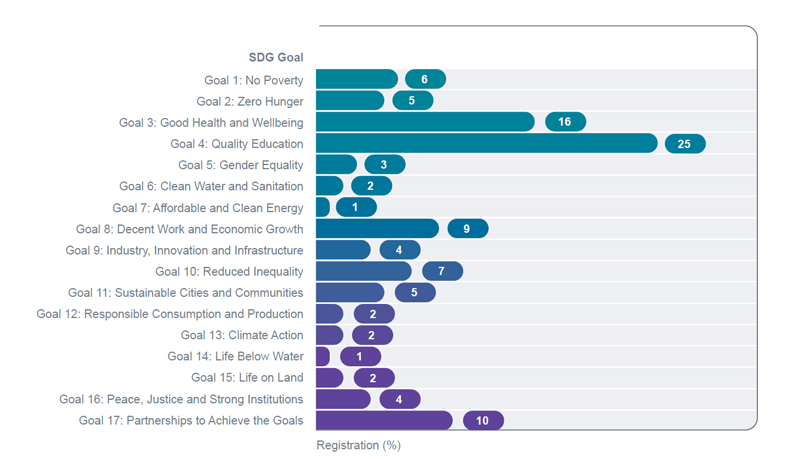
In 2024, there were 996 alignments between our community engagement
activities and the SDGs.
Quality education (SDG 4) accounted for 25% of SDG-related activity,
followed by health and well-being (SDG 3) at 16%
and then partnerships for the goals (SDG 17) at 10% and decent work
and
economic growth (SDG 8) at 9%.
The figure below shows the connections between our community
engagement
activities and the SDGs.
Adding value through engaged scholarship
When we integrate community engagement activities with teaching,
learning
and research, we can generate greater value for our external
stakeholders.
In 2024, the sharing of expertise accounted for 18% of engaged
scholarship activities, followed by service learning at 5% and
work-integrated learning at 3%.
For the first time, the NWU Community Engagement Showcase was held at
the
Mahikeng Campus, where we highlighted 93 CE initiatives with
societal
impact and implications for sustainable development.
Meanwhile, we continue to update our database of local NGOs, public
benefit organisations (PBOs) and religious institutions to support
student placements.

Material matter:
Teaching and learning; research; community engagement
We have incorporated community engagement into many teaching and
learning
activities, mostly through WIL and SL
opportunities for students and knowledge sharing from our academics.
With WIL, the main focus is on the learning benefits for the
students.
SL, on the other hand, is more about service to
community and industry partners.
Two flagship community engagement projects of 2024 were our Science
Shop
collaboration with the Department
of Science and Innovation, National Research Foundation and South
African Agency for Science and Technology
Development, and the Second Youth Learning Festival.
The Science Shop drives six microprojects aligned with key SDGs and
empowers communities through support with CV
writing, green place making and digital literacy training.
The second NWU Youth Learning Festival provided workshops on digital
literacy, robotics, entrepreneurship, career
guidance and environmental preservation for unemployed youth from
Khuma
and Mandawana.
The NWU’s eight faculties undertook a wide range of engagement
projects,
details of which can be found in the section
of the DHET report.
Material matter:
Research
In 2024, the NWU’s researchers and inventors undertook 23 engaged
research and innovation (ERI) projects with
external partners. Fifteen of these entailed contract research with
community partners and eight focused on research
with communities.
The prevalence of applied research demonstrates a practical approach
towards finding solutions for real-life problems,
leveraging partnerships with communities, industry and government.
Potential areas for growth are commercialisation initiatives, policy
analysis and consulting.
Opportunity also lies in postgraduate student-led research,
especially
when aligned with the SDGs and integrated
into theses, dissertations and publications. Funding our engagement
efforts remains a challenge. Some 46% of our
community engagement projects operated without funding in 2024. For
those project where funding was available,
internal funding covered 30% of activities, external sources 18% and
fundraising 6%.
Material matter:
Student value proposition; develop and retain excellent staff
Our students and staff are increasingly engaged in projects that
directly
improve the lives of others facing hardship, such
as the Meal-a-Day programme, which ensured that first-year students
awaiting NSFAS bursaries did not go hungry.
The Student Campus Council (SCC) on the Mahikeng Campus led a
sanitary
pad collection drive that set the world
record for the longest line of sanitary pads, and spearheaded
multiple
donation drives, rallying the community to donate
food, toiletries and clothing to people in need.
The NWU Netball – Mahikeng Campus management hosted the second annual
NWU-Schools Tournament, fostering
sports development and skill-sharing among local learners.
At the Potchefstroom Campus, PUKfm radio and the student newspaper
Wapad
launched a community clean-up
initiative, collecting litter in the Bult area.
Students on the campus also provided psychometric assessments to
assist
Grade 9 students with subject choices.
The Vanderbijlpark Campus SCC contributed to meal-a-day events, the
67
Minutes for Mandela clean-up campaign and
“Kindness in ink”, a mental health awareness project.
Students on this campus also engaged in environmental activism
through a
project aimed at rehabilitating the Vaal River. They ran a campaign
for
Suicide Awareness Month, collected food for animal welfare
organisations
and championed gender-based violence awareness. NWU staff
volunteered
their time and expertise in various community projects, from
mentorship
to hands-on involvement in community initiatives.
Challenges and future outlook
While technology and online education offer avenues for greater
engagement reach and accessibility, the digital divide impedes
progress,
hindering social justice efforts. We are addressing this by donating
72
redundant computers to deserving community partners.
We have also largely overcome the challenges some stakeholders faced
in
transitioning from manual to online registration on the NWU’s
stakeholder database.
Three stakeholder forum meetings were held with partners in 2024 and
three more are planned for the coming year. The intention is to work
together to set targeted objectives that address our partners’ needs
and
identify opportunities to engage with NWU experts who can assist
with
any challenges identified.
Entrepreneurship, environmental responsibility and digital literacy
are
central to our focus on advancing the SDGs and the African Agenda
2063.
Just a few of the projects that support these objectives are the
bHive
Enterprise for small businesses and entrepreneurs, sports
development in
townships and under-resourced areas, and skills development and
leadership training for youth and female entrepreneurs.
GOALLOUT PUSHES FOR FREE
SANITARY
PADS
GoAllOut, a student-led organisation at the NWU
Mahikeng
Campus, is pressing for legislative action to
provide
free sanitary pads in schools and public spaces.
“We advocate for the provision of free sanitary pads
as
we want to promote female hygiene and take a stand
against period poverty,” says Karabo Moalusi, a
GoAllOut
representative.
“Government’s commitment to fighting HIV through free
condoms is commendable. It shows the state has the
resources to address major public health issues. The
same dedication should be applied to sanitary pads,
but
not at the expense of condoms,” Karabo says. “The
struggles for free condoms and free sanitary pads
are
linked; both are about securing full reproductive
and
sexual rights for all South Africans.”
Luyanda Zulu, GoAllOut president, describes period
poverty as a challenge that affects access to
education,
social inclusion and health. “For many girls in
South
Africa and across Africa, menstruation means missing
school, facing social stigma and being exposed to
health
risks due to a lack of sanitary products.”
After setting a Guinness World Record in 2024 with
its
"Pad the Way" initiative, the group is now
collecting 50
000 signatures to push for government intervention
in
period poverty.
GoAllOut gained attention last year by assembling a
3,5km-long line of 51 870 sanitary pads and
collecting
more than 100 000 pads through corporate
partnerships.
This year the organisation aims to collect even more
sanitary pads, not only to break the record, but
also to
continue to push for menstrual health awareness.
Luyanda adds that the campaign extends beyond product
donations, and that GoAllOut is seeking broad public
support to push lawmakers toward policy change.
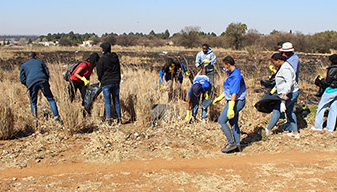
Student Life at the Vanderbijlpark Campus organised a
community clean-up project on Nelson Mandela Day on
18
July 2024.
Students and Expanded Public Works Programme (EPWP)
employees joined hands to clean up areas along
Hendrick
van Eck Boulevard and Frikkie Meyer Street in
Vanderbijlpark.
The 108 participating students were divided into
three
groups: semi-finalists from Mr and Miss Campus,
societies and chapters and residences, and alongside
EPWP employees demonstrated their commitment to an
ethic
of care and looking after the environment.
































 INTEGRATED ANNUAL REPORT | 2024