


OUR VICE-CHANCELLOR'S REVIEW
Our commitment to adaptability, agility, sustainability and innovation is at the core of our strategic vision, Taking the NWU forward – 2024 and beyond.
After Council approved this strategy in September 2023, we began establishing a fit-for-purpose institutional structure that supports efficiency, strengthens operational effectiveness and positions the NWU for sustainable growth. The process has been ongoing, and the structure is scheduled for implementation in June 2025.
In aligning our structures with our long-term vision, we are shaping a university that is future-ready and able to continue serving as a catalyst for positive change in South Africa and globally.
These activities are geared towards sustaining and supporting our core offering of teaching and learning, research and innovation, and community engagement. In preparing our students for the workforce of the future, we consider emerging socio-economic realities and technological changes.
Since implementing our strategy, we have made progress in defining our service delivery model, allocating resources more efficiently and positioning ourselves as a future-fit organisation.
An important part of this is the Vice-Chancellor's Special Dispensation Award, a retention incentive directed at improving and enhancing the remuneration of our staff. The award has significantly boosted the morale and job satisfaction of our staff, as evidenced in the 2024 Culture Survey.
During 2024, Council approved the cascading management structure, consisting of the structures, functions and positions that follow the top layer of management. The transition to this structure commenced with the vice-chancellor holding town hall meetings. Next, follow-up information sessions were held with a wide range of role players: unions, the SRC and the various governance structures.
We strive to attract and retain highly skilled employees with an innovative mindset. Our integrated talent management mechanisms include strategic workforce planning, talent attraction and management, targeted recruitment, optimal remuneration and benefits management, training and development, performance management and succession planning.
Succession planning ensures that key leadership roles are filled seamlessly with well-prepared internal candidates. This proactive approach minimises disruption, fosters institutional knowledge transfer and cultivates a pipeline of future-ready leaders aligned with the NWU's strategic vision.
The Leadership Academy has played a critical role in equipping our current and future leaders with the skills to navigate a dynamic higher education landscape. In 2024, we expanded the academy's offerings to include modules on digital transformation and inclusive leadership practices.
We are building a workplace culture that values talent, rewards excellence and provides opportunities for growth. By focusing on competitive remuneration, professional development and clear career progression pathways, we aim to create an environment where top talent thrives. We have now implemented a promotion pathway for support staff.
It is important to us to align staffing structures with the university's long-term goals. As part of this process, we are ensuring that staffing levels are optimal, that we retain high-performing employees and enable leadership continuity.
By prioritising our people, we are sustaining a robust and agile workforce capable of navigating current challenges and seizing future opportunities. Some of the futurefocused staffing initiatives are succession planning, leadership development, mentor and mentee programmes and staff retention efforts.
In 2024, the total staff headcount stood at 11 082, down from 11 523 in 2023.
Staff numbers increased in both the support and academic environments. Our support cohort showed a decrease of 433 employees – from 8 016 in 2023 to 7 583 in 2024. There was a decrease of eight in our academic staff, which dropped from 3 507 in 2023 to 3 499 in 2024. The following table shows these movements.
| Total staff headcount – 2023 versus 2024 | ||||||
| Classification | Permanent | Temporary | Total | |||
| 2023 | 2024 | 2023 | 2024 | 2023 | 2024 | |
| Academic | 1 692 | 1 696 | 1 815 | 1 803 | 3 507 | 3 499 |
| Support | 2 570 | 2 570 | 5 472 | 5 013 | 8 016 | 7 583 |
| Grand total | 4 236 | 4 266 | 7 287 | 6 816 | 11 523 | 11 082 |
Employment equity targets are closely monitored. The two committees of Council responsible for this are the People and Culture and Employment Equity Committee and the Transformation Oversight Committee.
We began working towards new targets, based on the successive employment equity plan that Council approved for January 2024 to December 2026. The targets and outcomes for 2024 are shown in the following table
| Race | 2024 target | % total | 31 December 2024 actuals | 31 December 2024 % Total |
Difference | Target achieved Y/N |
||
| Male | Female | Male | Female | |||||
| African | 23,45% | 21,86% | 45,32% | 22,57% | 23.36% | 45,92% | 0.61% | The NWU's Preferential procurement Strategy prioritises the involvement of local SMMEs in procurement tenders. Community liaison officers (CLOs) on each campus help implement this strategy and facilitate the inclusion of local SMMEs as subcontractors on large construction projects. The CLOs also work with the university's supplier development team to manage labour reporting and other compliance matters. In addition, two social facilitation companies engage with communities on the NWU's behalf. During 2024, we updated our dedicated database of local SMMEs and organised workshops for SMMEs on topics such as Construction Industry Development Board grading, compiling occupational health and safety (OHS) files, and completing tender documents. Local SMME participation is a standard requirement for tenders, especially in construction and services. A specialist supplier development officer oversaw the growth of local suppliers and facilitated their involvement in university contracts. Ten vetted local contractors were added to a panel for minor construction projects under R1.5 million. Looking aheadY |
| Coloured | 3,58% | 4,31% | 7,89% | 2.91% | 3.97% | 6.87% | -1.02% | N |
| Indian | 1,01% | 1,16% | 2,17% | 0,69% | 0,96% | 1,65%, | -0.52% | N |
| White | 16,43% | 26,07% | 42,50% | 16,75% | 26,44% | 43,19% | 0.69% | N |
| Foreign nationals | 46,10% | 0,47% | 2,12% | 1,75% | 0,62% | 2,37% | 0.24% | N |
| 1,65% | 53,90% | 100% | 44,67% | 55,33% | 100% | 0,00% | ||
When filling vacancies, we are guided by our Employment Equity. In recent years, however, there have been fewer vacancies to fill because of the moratorium on staff vacancies. This was implemented to contain costs in response to the reduced subsidy and cap on student fees, and has negatively affected our ability to reach the employment equity targets.
In addition, we use the following five strategies, spelt out in the employment equity plan for 2024 to 2026, to meet the employment equity targets:
- Identify and address barriers affecting people from the designated groups and people living with disabilities
- Accelerate the placement of women in leadership positions
- Succession planning for critical and scarce positions
- Retention strategies
- Embedding an inclusive organisational culture
Among our academics, we focus on building the seniority of our staff profile, using retention strategies and succession planning to maintain low attrition rates and offering competitive academic remuneration.
The aim is to be a diverse, transforming, critical-thinking, respectful and values-driven institution with a high‑performance ethos, an enabling leadership culture and a shared vision of the way forward.
The NWU is a leader in the higher education sector in using data analytics and synthesis to translate data into actionable strategic intelligence that brings us closer to successfully implementing our strategy and achieving our goals.
Our Strategic Intelligence department is skilled at creating dynamic information tools that empower stakeholders to interact with data in ways that generate nuanced, relevant insights.
These tools enhance the reliability, accuracy and timeliness of our data as they facilitate real-time data exploration and analysis employ advanced data modelling techniques.
In the short term, our goal is to revamp our data warehouse architecture so that it is flexible enough to incorporate varying business rules for new enterprise resource planning systems. For example, we are updating our Student Information System (SIS) and preparing to replace the learning management system (LMS).
Our longer-term goal is to expand our data architecture to include additional data sources, such as the new SIS, and possibly external data sources such as LinkedIn.
Our co-curricular programmes are growing from strength to strength on the three campuses of the NWU. Participation in arts and culture, sports, community engagement and student leadership initiatives is growing and service delivery levels are high thanks to innovations such as digital platforms and solutions for delivery of co-curricular. However, technology augments rather than replaces in-person engagement, which many students prefer.
What works well, in our experience, is to use mixed modalities to deliver student services and co-curricular programmes. This approach is flexible and allows for increased student engagement and participation, while also making information, programmes and services even more accessible to students.
Our students achieved national and international success in the arts and in sports competitions and tournaments.
In the arts, we applauded as the NWU Serenaders secured third place in the Large Category at the Tiro Mpane National Choral Eisteddfod and the NWU Voices of the River Choir won the Lengau Choral Music Association (LECMA) Competition. The Patria Men's Residence emerged victorious in the Atterbury Trust National Acapella Competition held in Gauteng. In other accolades, the PUKfm Radio Station was named the best Afternoon Show at the 2024 Telkom Radio Awards and, in Spain, the NWU Boulevard Harmonists were awarded the grand prize during the Gala Concert of the Musica Del Mar Festival in Spain. We also invested in the future by hosting the first Mafika High School Debate tournament for local schools in Mahikeng.
On the sporting front, the NWU was represented by seven athletes at the 2024 Paris Olympics, and two student athletes at the Para-Olympic games. Jo-Ané van Dyk and Bradley Nkoana won silver for javelin and the 4x100 relay, respectively.
On home soil, the NWU Young Guns won the Varsity Cup and our cricket, tennis and chess teams were placed first in the 2024 USSA tournaments, along with our bodybuilders and aerobics and dance club teams. The Vanderbijlpark Campus under 21 rugby team won the Valke Peregrine championship and the first team won the Community Gold Cup.
In 2024, we successfully introduced a digital platform, Altron HealthOne Connect, for comprehensive clinic and patient management at our Campus Health Care Centres (CHCCs).
The CHCCs again to conduct focused campaigns on female reproductive and primary healthcare services. There was a strong emphasis on monitoring the implementation and effectiveness of the Rules and Guidelines on the Support and Accommodation of Pregnant Students. The aim is to ensure pregnant students receive reasonable support during the pregnancy to successfully complete their academic programme.
The NWU again benefited from grant funding from Higher Health, operating in partnership with the DHET and Universities South Africa (USAf) and other funding organisations. The purpose of the grant is to support the primary healthcare, psycho-social and social welfare projects offered by the institution.
Social welfare programmes such as the Meal-a-Day programme remained under pressure amid increased demand from the student community. We are aware of the pressing need for a longer-term sustainable programme of social welfare support for our students.
In 2024, the network of 200 peer helpers (volunteer student lay counsellors) was active on our campuses. They contribute to educational campaigns on anxiety, depression, adapting to change and mental health, among other things, and are a core driver of psycho‑social referrals to professional counselling, ensuring that students have access to mental health services.
We collaborated in several initiatives to eradicate gender‑based violence (GBV). During the June/July 2024 recess, the NWU hosted the National Conference on GBV and femicide, in collaboration with the National Community of Practitioners.
We also participated in the Commission for Gender Equality (CGE) study on the prevalence of GBV and sexual harassment at higher education institutions in South Africa. An NWU delegation subsequently formed part of the CGE Policy Dialogue on 10 December 2024.
Student-led initiatives included “My Sister's Keeper”, which highlighted the collective duty of care towards our female students.
During the 2023/24 student leadership term, approximately 1 100 student leaders were active in student leadership structures, including the Student Representative Council, Campus Student Councils, residence house committees and student academic chapters
Students were also represented in the university's key decision-making bodies, notably Council, Senate, Faculty and support services committees and forums.
The Student Leadership Academy hosted the second annual Student Leadership Summit in September 2024 under the theme “Future leaders: Embracing change and innovating tomorrow”.
Student Life also succeeded in standardising the development of aspiring student leaders across the three campuses through the Prestige Leadership Development Programme.
We refined and improved the orientation programme for first-year students. The 2024 programme included an introduction to university life, orientation on faculty stakeholders and processes, the NWU's vibrant student experience, student leadership structures, support services for student academic support, the learning management system, and psycho-social and primary healthcare services
In response to the positive uptake of Work Integrated Learning (WIL) and Service Learning (SL) at the NWU, we have invested in extensive system-related technology support, as well as service-learning workshops for focused academic and curriculum-related support.
The Work Integrated-Service Learning (WISL) management committee invited NWU schools to propose enhancements for WISL in their environments. Schools confirming optimal functioning include Nursing, Pharmacy, Biokinetics, Dietetics, Occupational Health, Consumer Sciences and Social Work.
University teachers are expected to master 4IR skills such as creating multimedia videos, technologies and graphics, among others. The NWU, in collaboration with the Centre for Higher Education and Professional Development (CHEPD), has been instrumental in supporting, planning and co-developing the MEd degree for 2025. This degree is tailored to meet the evolving needs of higher education professionals. The changes in South Africa's skills programme environment will affect the NWU's approach to the delivery of short courses. On 30 June 2024, responsibility for developing and quality assuring skills programmes was transferred from the Sector Education and Training Authorities (SETAs) to the Quality Council for Trades and Occupations (QCTO).
To stay competitive and meet evolving industry requirements, we will need to begin aligning our short courses, where feasible, with the QCTO modules. This will necessitate obtaining QCTO accreditation for each module or programme. While this accreditation process is likely to be resource-intensive, it offers significant longterm advantages for the marketability and relevance of our courses to industry.
We have continued to solidify our position as a transformative, future-focused institution committed to impact, diversity, internationalisation and strategic partnerships.
Our engagements and partnerships span all spheres of government, reinforcing our commitment to influence policy, promote research excellence and foster regional development.
Our growing involvement with the Department of Economic Development in the North West Province marks a critical step in advancing the development of small, medium and micro enterprises (SMMEs), entrepreneurship, tourism and parks management, directly impacting economic transformation and student employability.
We are also expanding partnerships with non-profit organisations, civil society and industry, ensuring that our academic and research outputs remain deeply integrated with societal needs.
Internationally, we signed strategic MoUs with institutions such as the University of Kigali and West Indies University.
We continue to work with the International Atomic Energy Agency and have ongoing engagements with institutions such as the Karl Landsteiner Private University in Austria, Copperbelt University in Zambia, the University of Botswana and the University of Arizona in the United States, among others.
In addition, we have created new linkages with the University of Liverpool, University of Sciences and Technology of Oran Mohamed Boudiaf, Mohammed VI Polytechnic University and the University of Nairobi. These offer unique collaborative opportunities in mining engineering, alternative energy research, public health, international grant funding and graduate employment initiatives.
We are fully committed to student success and capacity‑building, demonstrated through our ability to mobilise funding from industry leaders such as the Public Service Education and Training Authority (33 bursaries and 33 internships) and BP Southern Africa, while fostering new funding relationships with ABSA Bank, AfroCentric and other financial partners. These efforts are geared towards ensuring financial access for students, particularly the “missing middle”, and bridging the gap between academic excellence and economic opportunity.
Simultaneously, the NWU is strengthening its role in addressing youth unemployment and underemployment by securing graduate programmes and internship opportunities.
In 2024, we hosted several high-impact events providing platforms for intellectual discourse and strategic networking. These include the Vice-Chancellor's Business Dinner, a number of public lectures and the National Press Club's Newsmaker and Journalist of the Year Awards, of which the NWU is the official sponsor.
Our focus on science and innovation was evident through initiatives such as the Vice-Chancellor's Science Day in Greater Taung in July 2024, aligning with our drive to strengthen science, technology, engineering and mathematics (STEM) education.
Another key highlight was the benchmarking visit of student leaders to Rwanda, which provided critical insights into student leadership, entrepreneurship and responsible citizenship.
The NWU continues to set the bar in accounting education, as demonstrated in the latest South African Institute of Chartered Accountants' Initial Test of Competence (ITC) results. the NWU's 2023 Postgraduate Diploma in Accounting (PGDA) class achieved an outstanding pass rate – rising from 97% in January to 99% in June. This places the NWU second in the country for postgraduate accounting.
As the university moves forward, we remain committed to sustainability, operational excellence and strategic impact, ensuring that our partnerships, research and student initiatives align with global best practices while addressing pressing societal challenges.
Key strategic projects were initiated in 2024, some of which will impact on the managerial and administrative activities of the university. The projects are in progress and expected to gain momentum in 2024 and will be fully reported on in due course. These include the following.
The fiduciary board convened on 13 August 2024 and has since met three more times. The process of finalising the shareholder agreement to reflect the decision of the Council in relation to NWU Enterprises is underway.
As NWU Enterprises enters 2025, four potential proposals are under consideration, marking an important step in its development and future growth and the enhancement of third-stream income.
On 3 April 2024, the NWU held its inaugural mining indaba that focused on launching a School of Mines and Mining Engineering
The NWU team also conducted a benchmarking visit to the Zimbabwe School of Mines on 20 and 21 August 2024.
The then Minister of Higher Education and Training, Dr Nobuhle Nkabane, expressed full support for the establishment of the NWU medical school. In a letter to vice-chancellor Prof Bismark Tyobeka, she commended the university's commitment to addressing scarce medical skills and pledged the Department of Higher Education and Training's partnership in the project.
The NWU medical school, set to become South Africa's 11th, is a collaborative effort with the North West Provincial Government to strengthen healthcare in the province. Key milestones, including curriculum approval and submission to the Health Professions Council of South Africa (HPCSA), were achieved in 2024.
In 2025, the university will finalise accreditation, infrastructure development and staff appointments, aiming for its first student intake in 2028. The official launch and partnership announcements are planned for early 2025.
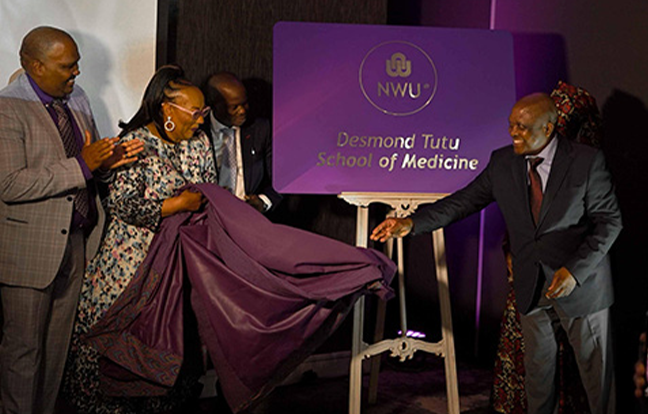
The NWU announced that its soon-to-be-established medical school will be honorifically named the NWU Desmond Tutu School of Medicine.
This decision was taken in consultation with – and received the approval of – the Archbishop Desmond Tutu IP Trust.
The official naming ceremony took place on Tuesday, 22 April 2025. The name was unveiled by Dr Anna Mokgokong, Chancellor of the NWU, Bert Sorgdrager, Chairperson of the NWU Council, Prof Bismark Tyobeka, Principal and Vice-Chancellor of the NWU and Dr Mamphela Ramphele, Chairperson of the Archbishop Desmond Tutu IP Trust.
To learn more click here
 INTEGRATED ANNUAL REPORT | 2024