


NWU VALUE CHAIN
In 2024, as we marked 20 years as an institution, we found ourselves walking a familiar yet ever-changing road — one shaped by transformation, growth and deep impact. It was an opportunity to look back and acknowledge a journey of resilience, vision and the pursuit of excellence without boundaries.
Over the years, we have learned to adapt and evolve in a shifting higher education landscape where technology and global events impact the way we do things. Our constant aim is to reach beyond expectations on the strength of our capitals. The building blocks for the shared future we are shaping are our people, our spaces, our knowledge and our resources.
At the heart of the NWU story are our students. They are not just recipients of knowledge, but co-travellers – dreamers, doers and thinkers who walk with us as we chart new frontiers. We invest in them because we believe in the power of their potential. Every lecture, mentorship, project and community initiative is designed not just to teach, but to transform..
Each success, every graduate, is a testament to this mission. Our alumni leave the university not only with degrees, but with purpose. They lead, they question, they change the spaces they occupy. Their journey becomes part of our own, stretching our impact far beyond campus borders.
As our story unfolds, so too do our partnerships with our communities and industries and in the global arena. These relationships strengthen our social and relationship capital, opening doors to even greater possibilities.
The road ahead is full of promise. With every step, we remain committed to growing, crossing new boundaries and turning potential into lasting, meaningful change.
Our student body is an invaluable input into our value chain. The diagram below reflects the composition and size of the student body in 2024 as compared to 2023:


Our recruitment activities in 2024 contributed to the university receiving more than 390 000 applications, including 71 000 applicants with an APS of 30+. As a result, we achieved the enrolment plan targets and attracted top-performing prospective students.
With the aim of facilitating student access and success to quality higher education, we set out to recruit prospective students through school visits, career fairs, career guidance events, campus visits, open days, and activations and sponsorships.
Hybrid events and technology enabled us to reach more communities and prospective students. In addition, the 88 athletics and sports meetings we hosted played an important role in student recruitment. The Young Eagles Recruitment programme, focusing on top-performing and diversity students, was extremely successful.
Initiatives such as Ikateleng and the Science, Engineering, Technology and Health (SETH) project also continually aim to broaden access and increase the potential in STEM-related fields. (See the next section on broadening access to studies for more details of Ikateleng.)
Ensuring access to quality education for as many of our citizens as possible is part of the mission of the NWU. This is also part of our commitment to helping achieve the United Nations’ sustainable development goals. Goal 4, Quality Education, guarantees inclusive and equitable quality education for all, and promotes lifelong learning.
Various NWU initiatives contribute to greater access, including our community programme Ikateleng, which means “empower yourself”.
We started Ikateleng 34 years ago. Since then, it has changed the lives of thousands of learners in Grades 10 to 12 who have received supplementary lessons in mathematics, economics, business studies, accounting, life sciences, physical sciences and English.
We also run one-year University Preparatory (UnivPrep) programmes for prospective students who do not meet the admission requirements. Alternatively, they can enrol for one of the various higher certificates in economics and management sciences, humanities and theology.
Our Bridging the Mathematical Gap (BTMG) modules offer a pathway to BCom or BSc studies for students whose matric mathematics results do not meet the admission requirements and who are enrolled for formal BA studies at the NWU.
We also have several extended programmes in commerce, science and information technology to give students greater access.
The future employability of graduates is critical and integral to our teaching and learning strategy. For this reason, we are reviewing our programme offerings to ensure they are relevant and viable, and meet the demands of the 21st century world of work.
We liaise with professional bodies so that our students can obtain professional affiliations when they graduate, and we provide opportunities such as career fairs where students and prospective employers can engage. Students also have access to training in CV writing, work readiness and entrepreneurship.
Through regular engagement with industry partners, we strive to understand their skills needs and obtain feedback on how our graduates are performing in the market.
Furthermore, the NWU’s Alumni Relations office has initiated a mentorship programme to help prepare students and young alumni for work.
In 2024, unemployed graduates and postgraduate students attended workshops on CV writing and interview skills and we connected with potential employers.
More and more of our students rely on financial aid. In 2024, our financial aid offices administered R3,957 billion.
Government contributed 84% of this funding, amounting to R3,322 billion in 2024. This included the Funza Lushaka bursaries administered by NSFAS. However, R55 million of the 2024 Funza Lushaka allocation was only disbursed by January 2025, delaying the provision of financial support for some students.
The NWU contributed R281 million (compared to R250 million in 2023) for student bursaries. This commitment helps increase our student throughput, promote social justice and support student success.
We launched a pilot postgraduate project offering full-cost bursaries to high-performing honours students. Several students were selected for full bursary support in 2025.
The NWU provides focused academic support, enhancing our students’ prospects of academic success.
Just as important is the non-academic support we offer, such as psychosocial, health, sport and arts and cultural services, aimed at developing our students holistically.
A significant input into our value chain is our staff complement.
The next table compares the number of permanent academic staff at the NWU compares with academic staff numbers at seven other top South African higher education institutions (Please note that this is based on 2023 audited HEMIS data):
| Institution | Total |
| University of KwaZulu-Natal | 1 176 |
| University of Cape Town | 1 192 |
| University of Witwatersrand | 1 211 |
| University of Pretoria | 1 269 |
| Stellenbosch University | 1 295 |
| University of Johannesburg | 1 328 |
| North-West University | 1 692 |
| University of South Africa | 1 823 |
In 2024, we had 4 266 permanent staff members, comprising 1 696 academics and 2 570 support employees.
We provide excellent training and development for our staff. In 2024, we again focused on developing digital skills for the NWU’s Digital Transformation Strategy.
As high stress levels and burnout are prevalent 21st century risks, we have increased the support available through our Employee Assistance Programmes and extended their reach through online support. For more about this, refer to the section on how we perform against our strategy.
The annual academic promotions process is a recognition programme for academics and also creates value for the NWU.
| Academic promotions 2022-2024 | |||||||||
| Promoted to: | Black | White | Total | ||||||
| 2022 | 2023 | 2024 | 2022 | 2023 | 2024 | 2022 | 2023 | 2024 | |
| Lecturer | 5 | 8 | 10 | 7 | 16 | 3 | 12 | 24 | 13 |
| Senior Lecturer | 5 | 30 | 14 | 18 | 30 | 5 | 23 | 60 | 19 |
| Associate Professor | 19 | 16 | 11 | 36 | 35 | 31 | 55 | 51 | 42 |
| Professor | 7 | 10 | 5 | 18 | 16 | 17 | 22 | 26 | 22 |
| Grand total | 36 | 64 | 40 | 79 | 97 | 56 | 115 | 161 | 96 |
| Percentages | 31,3% | 40,0% | 37,8% | 68,7% | 60,0% | 62,2% | 100% | 100% | 100% |
Academic promotions assist in preparing academics for greater responsibilities. In 2024, the NWU approved 96 academic promotions.
We are busy strengthening the advancement pipeline for black females, whose promotion rates have been the lowest for some years.
Lecturer-level promotions doubled in 2024, highlighting the impact of NWU’s investment in academic development.
The competitive South African university landscape presents significant challenges in recruiting and retaining academic staff. To mitigate this risk, we prioritise a holistic, supportive and engaging work environment. This requires a shift from focusing solely on individual well-being to fostering institutional well-being and a workplace climate that promotes staff retention and organisational effectiveness.
The NWU’s employee health and wellness programme integrates three types of support:
- psychosocial support, consisting of 24/7/365 counselling, including legal and financial guidance;
- physical well-being initiatives centred on activities that promote health and resilience; and
- organisational effectiveness interventions such as workplace well-being assessments, training and leadership support.
Recognising the critical link between well-being and performance, the Wellness Unit offers targeted interventions in:
- stress management and managerial consultancy;
- enabling work environments and effective communication;
- sensitive issues such as gender-based violence and substance abuse; and
- support for personal and professional challenges.
By investing in workplace well-being, the NWU strengthens individual resilience, organisational culture and long-term institutional success. This people-centric strategy will remain a cornerstone of NWU’s 2025 vision.
Leadership development and succession planning
The NWU expanded coaching interventions for senior managers, enhancing leadership capabilities and strategic decision-making.
Our Leadership Academy continued to develop future academic leaders, while tailored succession planning ensured continuity in key roles.
In 2024, the Leadership Academy was extended to support staff, equipping managers with essential leadership skills to strengthen teams and drive institutional success.
The “Women in leadership programme provided structured training, mentorship and networking to empower women across all career levels.
Focus on designated groups and scarce skills
We intensified efforts to attract and retain academic staff from designated groups and scarce skills areas. Differentiated cost-of-living adjustments (COLA) provided higher increases to critical skills academics and lower-level employees affected by rising living costs. We conducted individual remuneration reviews for high performers and paid scarce skills allowances to strengthen retention.
Strengthening the employee value proposition
Through targeted incentives and structured career development programmes, we enhanced the representation of designated groups, particularly black academics.
Fair and market-related remuneration remained a priority, while professional development opportunities were extended to support staff as part of an integrated talent management approach.
Optimisation and cost-containment measures
Despite budget constraints, the NWU continued its staff optimisation process, leveraging efficiencies and technology to generate cost savings for staff remuneration. Innovative solutions were explored to enhance working conditions while maintaining a supportive and inclusive workplace.
Employee wellness and benefits
Medical aid support remained in place for lower-level employees, ensuring financial security. Wellness initiatives were expanded to promote mental and physical well-being, reinforcing the critical role of well-being in staff retention.
Through these strategic responses, NWU has reaffirmed its commitment to retaining and attracting high-calibre academic staff, improving diversity and building a future-ready workforce capable of advancing the university’s strategic goals.
The NWU received approximately R99,1 million in research funding from the NRF in 2024 and the South African Medical Research Council (SAMRC). The table gives details of external grants awarded to the NWU in 2023 and 2024.
| Grant/Programme | Number of awards | Total amount | Number awards | Total amount |
| 2023 | 2023 | 2024 | 2024 | |
| MRC Funding | 6 | R2 082 501,00 | 6 | R2 752 475,56 |
| Thuthuka | 26 | R1 616 295,00 | 17 | R1 515 638,14 |
| Other Grant Holder Awards | 256 | R38 962 439,00 | 192 | R39 955 714,14 |
| Grant Holder Linked Bursaries | 14 | R2 620 000,00 | 11 | R2 740 000,00 |
| Block Grants | Discontinued | |||
| Freestanding Bursaries | 386 | R53 714 262,00 | 291 | R43 994 595,67 |
| Freestanding Post Doc Bursaries | 11 | R2 896 250,00 | 18 | R5 916 250,00 |
| Freestanding Post Doc Funding | 11 | R674 998,00 | 18 | R1 302 300,41 |
| SKA Student Bursaries | 2 | R365 354,00 | 2 | R378 113,00 |
| SKA Student Equipment | 0 | R0,00 | 1 | R31 000,00 |
| SKA Student Travel Grants | 0 | R0,00 | 0 | R0,00 |
| Grant Deposits | 1 | R15 400 000,00 | 1 | R16 300 000,00 |
As the grant holder-linked bursaries and block grant bursaries are being phased out, students will only receive freestanding bursaries in future.
In the event of any delays in receiving funding, researchers in some of the NRF programmes had the opportunity to defer their 2023 funds to 2024 or any future year.
As funding was limited, only three innovation projects were supported in 2024: one pre-seed project and two TIA Seed Fund projects.
The situation improved in 2024, with additional Seed Fund projects being supported. For 2025, the TIA -NWU funding agreement is being renewed.
The table below shows the international funding each faculty received during 2024.
The total amount, R45 703 389,30, was significantly higher than the R38,9 million received in 2023 and the R23,7 million received in 2022.
| 2022 | 2023 | 2024 | |
| International funding for research | Actual as confirmed by faculties | Actual as confirmed by faculties | Actual as confirmed by faculties |
| R | R | R | |
| Faculty of Economic and Management Sciences | 703 261 | – | 3 156 584,67 |
| Faculty of Education | – | 434 228 | – |
| Faculty of Humanities | 3 418 090 | 3 490 006 | 6 807 585,00 |
| Faculty of Engineering | 2 220 050 | – | 7 285 853,24 |
| Faculty of Health Sciences | 10 798 764 | 21 674 775 | 9 921 138,43 |
| Faculty of Natural and Agricultural Sciences | 9 985 580 | 12 844 763 | 18 532 228,07 |
| Total | 23 707 655 | 38 893 772 | 45 703 389,30 |
Both the university and our students must be agile enough to adapt to the new skills demands of the 21st century world of work.
With this in mind, we incorporate transferable, flexible skills into our academic offering, including analytical thinking and innovation, active learning and learning strategies, complex problem-solving and critical thinking, as well as creativity, originality and initiative.
Block teaching offers students the opportunity to focus on group projects and skills development. We have already successfully adopted this approach for selected programmes in the faculties of Economic and Management Sciences, Engineering and Health Sciences, and are considering expanding it to other faculties.
CelCat, the new timetabling system that provides the flexibility to consider alternative ways to schedule academic activities, was fully implemented in 2024.
Academic programme alignment across our campuses is ongoing, the aim being to offer comparable academic programmes and experiences and meet external quality section standards. More information on this can be found in the section on on how we performed against our strategy and increased our intellectual capital.
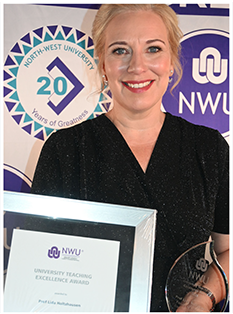
This year’s recipients of the University Teaching Excellence Award (UTEA) were Prof Lida Holtzhausen of the Faculty of Humanities and Prof De Wet Wolmarans from the Faculty of Health Sciences.
To read more about the excellence awards click here.
In 2024, staff wishing to enhance their role in student access and success attended training and capacity-building workshops and seminars. A total of 67 staff attended seven Siyaphumelela workshops on data-informed approaches to module reviews, using open educational resources (OERs) to transform quantitative skills development and student success, monitoring and evaluation, and academic advising, among others. A further 35 NWU staff and students attended the 2024 Siyaphumelela network conference.
We began conceptualising and developing a NWU student success plan on access, retention, attainment and success (ARAS). The first ARAS framework review workshop was held on 18 July 2024.
In addition, the Kresge Foundation approved funding for three years, from June 2024 to June 2027, for staff and student capacity development and to create an enabling data analytics environment to support student access, retention, attainment, and success, diversity and equity.
During 2024, we conducted two rounds of the Student Teaching and Learning Experience Survey, resulting in an overall student satisfaction rate of 83% in the first semester and 89% in the second semester. This is higher than in previous years.
The NWU’s Unit for Continuing Education (UCE) offers a comprehensive range of short courses for those needing just-in-time continuing education opportunities. Many of the UCE’s courses combine contact sessions, virtual classrooms and online content.
The short course administration system is fully automated, giving participants a single secure portal to manage their process from application to certification. This includes online payments and integrated external credit provision that reduces the risk of the NWU incurring bad debt.
The Continuous Professional Learning (CPL) Programme offers staff various career-stage opportunities focused on digital transformation. In 2024, the programme provided CPL opportunities through workshops, webinars, online courses and a Teaching and Learning conference, while also providing funding for teaching and learning-related colloquia or symposia. A total of 1 004 staff members attended 100 webinars and workshops in 2024.
The Centre for Teaching and Learning (CTL) kept academics abreast of the latest pedagogical advancements, digital teaching competencies and scholarly engagement strategies to enhance student learning.
The Induction Programme for Academics is compulsory for newly appointed academics in their probationary year and enhances their skills as university teachers. The revised CTL Induction Programme, which was launched in February 2024, deals with the NWU’s learning management system eFundi, blended learning, academic integrity, assessment and best practices in teaching and learning.
In 2024, 176 academics registered for the CTL induction programme and 73 had completed it by December 2024. Some 96% indicated they would recommend the programme to their colleagues, and 93% felt the programme positively impacted their teaching.
The hybrid international teaching mobility project for 2024 enabled selected academics and senior academic developers to engage in international teaching collaboration.
In total, 15 academic staff and three senior academic developers participated in the mobility activities in November and December 2024.
The collaborating universities were the Inholland University of Applied Sciences in the Netherlands, Lincoln University, Plymouth University and Oxford University in the United Kingdom, Ivane Javakhishvili University in Georgia and Munster in Germany.
The areas of collaboration, virtually and in-person, including nursing science, social work, theology and the use of artificial intelligence (AI) in higher education. These collaborations led to several collaborative international online learning (COIL) opportunities for nursing and social work students.
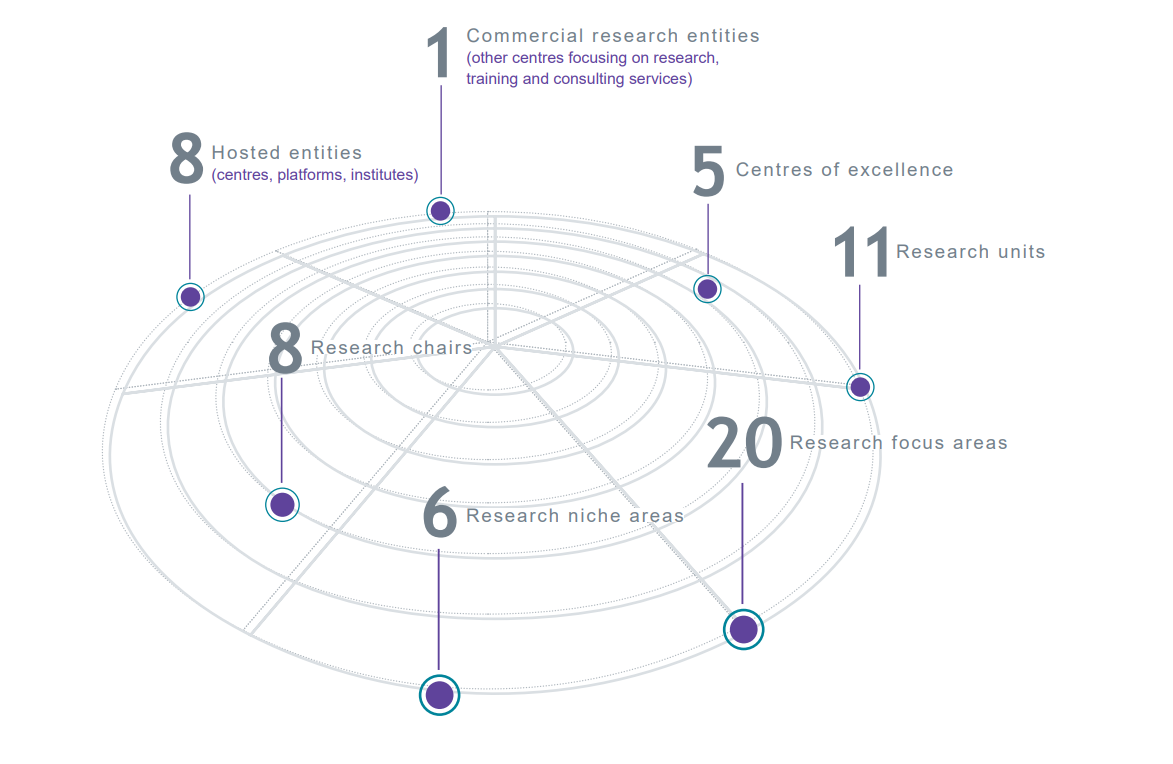
For 2024, most of our research and innovation activities were conducted across 59 research entities. These consisted of eight research chairs, eight hosted research entities (including a centre of competence), five centres of excellence, 11 research units, 17 research focus areas, 10 research niche areas and one commercial research entity.
Seven research entities were successfully evaluated externally in 2024.
| Date | Research Entity | Faculty | Research Entity Director |
| 18‑21 February | Focus Area: Chemical Resource Beneficiation | FNAS | Prof Henning Krieg |
| 25‑28 February | Focus Area: Material Science Innovation and Modeling | FNAS Mahikeng | Prof Ashmore Mawire |
| 18‑21 June | Centre of Excellence: Space Research | FNAS | Prof Amare Abebe |
| 14‑17 July | Centre of Excellence: Hypertension in Africa Research Team | Health Sciences | Prof Carina Mels |
| 18-21 August | Unit: Tourism Research in Economic Environs and Society (TREES) | FEMS | Prof Elmarie Slabbert |
| 15‑18 September | Focus Area: Ancient Texts: Text, Context and Reception | Theology | Prof Risimati Hobyane |
| 6‑9 October | Focus Area: Occupational Hygiene and Health Research Initiative (OHHRI) | Health Sciences | Prof Johan du Plessis |
The current NWU research landscape is shown in the following figure:
The Digital Scholarship Centre went into operation, laying the foundation for further development in support of innovative research initiatives.
We enhanced the structure and registration of DaYta Ya Rona on re3data.org, a global registry of research data repositories. This has significantly improved data management and access, both for the NWU and the research community at large. As part of this, we implemented sustainable development goals (SDGs) indicators, marking a strong commitment to the SDGs.
The NWU Data Management Plan Tool was also enhanced to provide detailed support for researchers throughout the entire data management process. This includes guidance on data collection, storage, sharing and preservation, best practices and complying with ethical, legal and funding requirements.
We digitised more than 2 653 pages on the DBText system and processed more than 2 468 exam papers.
In addition, to improve research visibility and impact, we activated the Intembeko ORCID Hub.
A total of 849 participants attended the webinars we co-hosted with Research and Postgraduate Support on Research and Open Scholarship Services (ROSS). These webinars covered reference management, researcher profiles, Scopus AI, data management, open access publishing through transformative agreements, and grant writing.
We published 500 articles through transformative agreements, making open access practices more accessible and impactful for our researchers.
Altmetric Explorer, which tracks thousands of online mentions in one platform, was integrated with Boloka (the Institutional Repository). This has enhanced the visibility and impact tracking of NWU’s research outputs by providing real-time metrics on how publications are being discussed and shared across various academic and non-academic platforms, while also highlighting their societal impact.
We have also expanded our Open Journal System (OJS) by adding three distinguished journals: the South African Journal for Research in Sport, Physical Education and Recreation (SAJRSPER), the Journal of Community Psychosocial Research (JCPR) and the International Journal of Indigenous Language Media and Discourse(IJILMD).
The undergraduate degree graduation duration factor was 1,12 in 2024, indicating that fewer students are completing their degrees in the minimum time.
The student-to-academic staff full-time equivalent (FTE) ratio was 30,09:1 (28,59:1 for 2023), meaning that one academic staff member is available for every 30,09 full-time equivalent students.
Among first-time entrants, the dropout rate for contact degrees increased from 8.86% in 2023 to 9.5% in 2024. It remains low in comparison to sector norms.
The following graph shows the number of graduates per field of study for 2023 and 2024:
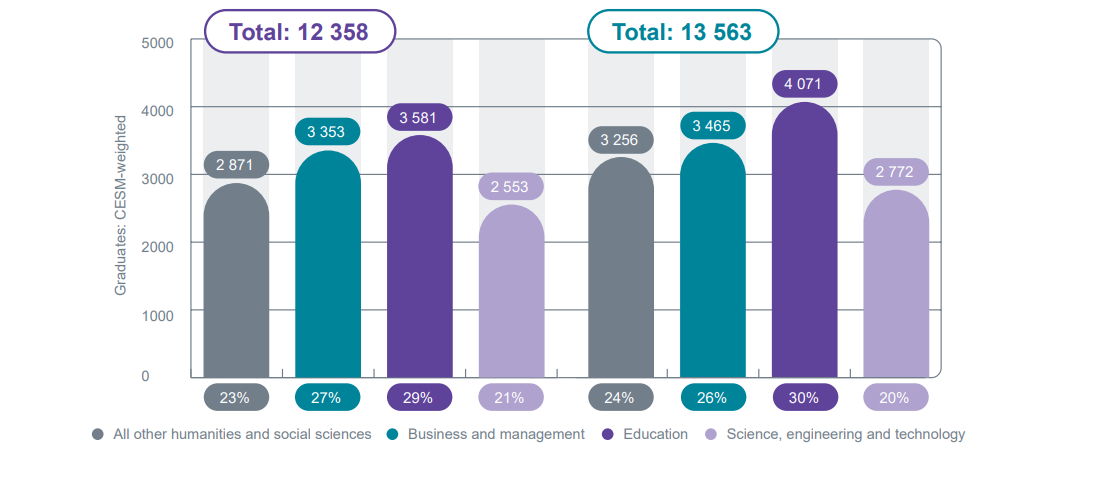
The following table compares the number of NWU graduates to those of other South African higher education institutions (based on 2023 audited HEMIS data):
| Institution | Total |
| North-West University | 12 358 |
| Tshwane University of Technology | 13 436 |
| University of Johannesburg | 13 506 |
| University of Pretoria | 14 306 |
| University of South Africa | 56 549 |
More than 130 staff members received recognition for their outstanding contributions in teaching and learning, community engagement, and research and innovation during the NWU Excellence Awards on 21 November.
Prof Bismark Tyobeka, the vice-chancellor, said the awards demonstrate the commitment of NWU staff who see education as a bridge to the communities that the university serves and who recognise that the NWU’s work has the power to make an impactful difference to humankind and the planet.
“These recognitions are a call to all of us at the NWU, to continue fostering an ethos of community-centred excellence,” Prof Tyobeka said. “We need to be inspired by these remarkable contributions to deepen our commitment to engagement, making our academic work ever more relevant and impactful as it is clearly articulated in our strategy document, Taking the NWU Forward: 2024 and beyond.”
Four categories of community engagement awards were presented in 2024. These were the Engaged Teaching and Learning Award, the Engaged Research and Innovation Award, Scholarship of Engagement Award and the Discipline-based Outreach Award. The names of the five recipients can be found here.
Awards for excellence in research, innovation, sustainability and community impact research were also presented in 2024.
Researchers were recognised in various categories, including the National and International Recognition and Memberships Award, Acknowledgement of New and Upgraded NRF Ratings, Acknowledgement of Research Chairs, Most Productive Senior Researcher Award, Most Productive Emerging Researcher Award, Creative Outputs Award, Top Inventor Award, Innovation Impact Award, S2A3 Award for the Best Master's Dissertation, and the Vice Chancellor’s Award.
In addition to the institution-wide awards, the annual Faculty Teaching Awards celebrated 49 outstanding lecturers across the NWU's eight academic faculties in 2024.
Research output*
The quality and quantity of research at the NWU continue to improve, as shown in the following table:
| 2021 | 2022 | 2023* | |
| Journal articles | 1366,3 | 1342,10 | 1372,1 |
| Conference proceedings | 66,9 | 91,5 | 106,5 |
| Books and chapters | 222,90 | 272,6 | 276,2 |
| Total article equivalents published | 1656,1 | 1706,2 | 1754,8 |
| Master’s degrees conferred | 698 | 695 | 750 |
| Research master’s | 509,962 | 519,076 | 547,523 |
| Research master’s weighted | 509,962 | 519,076 | 547,523 |
| Doctoral degrees conferred | 264 | 213 | 277 |
| Doctoral degrees weighted | 792 | 639 | 831 |
| Total weighted research output | 2 958,062 | 2 864,276 | 3133.,23 |
| Postdoctoral fellows | 212 | 205 | 206 |
| Publication units per permanent academic staff member | 0,99 | 1,02 | 1,04 |
| * | Please note that there is a two-year lag regarding the research output. |
Our inputs and activities result in outcomes, completing our value chain. These outcomes are intended to create longer-term value.
This future focus means that sustainability is an integral element of our outcomes. After we have taken care of immediate and medium-term needs, there must be sufficient capitals left to use for future value creation.
Financial stability is a good example of an outcome that supports our sustainability. When the NWU is financially stable, we can generate other outcomes, such as delivering skilled graduates to enhance the knowledge economy of the country.
Our research output is also an outcome. It strengthens our reputation (another outcome) so that we can attract high quality scientists, further build our human capital and ensure our future sustainability. This leads to another outcome in the form of solutions to real-life problems that leverage our research and innovation results.
In addition, the third leg of our core business, namely community engagement, creates outcomes by empowering people to improve their lives in a sustainable way.
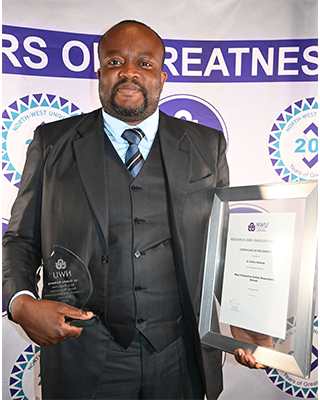
Prof Gabila Nubong of the Faculty of Economic and Management Sciences was the NWU’s Most Productive Senior Researcher.
PROF BISMARK TYOBEKA
CHAIRPERSON OF SENATE
 INTEGRATED ANNUAL REPORT | 2024