


Incentivising for achievement
The NWU creates an environment that motivates and reinforces superior performance on the part of our staff. In this way, we encourage high performance and harness the energies of our staff towards realising our strategy and goals.
Performance incentives are attractive and sustainable and are applied fairly and consistently.
Through integrated performance management, we recognise superior organisational, team and individual performance.
Through this approach, our staff are encouraged to explore career and learning opportunities, expand their capabilities and evolve individually and collectively.
Remuneration mix to attract and retain scarce and critical skills
Market-related remuneration is essential if we are to succeed in recruiting and retaining the best staff. Our remuneration mix has variable and fixed elements and includes monetary and non-monetary rewards. All these elements are aligned to our strategy, business-specific value drivers and the NWU values, ensuring a good skills and culture fit.
nnually, we do benchmarking to ensure continued competitiveness of guaranteed pay. Employees contribute 7,5% to the pension fund and can choose an employer contribution of 12%, 15%, 17,5% or 20%.
Variable pay includes performance bonuses and various value-adding allowances, and is paid according to the results of individual remuneration reviews.
Remuneration governance and management
The NWU Council fulfils its oversight function for remuneration through its Remuneration Committee.
This committee understands how the income differentials affect fair and responsible remuneration and contribute to the positioning of the NWU as a value-adding institution for employees and other stakeholders.
It is important to close the income differentials between the higher and lower salary bands, and also to address the enhancement of salaries of academic staff. The outcome of the collective bargaining process for salary increases for 2020 supported this by introducing a differentiated increase to cater for academic staff and staff at the lower income bands.
Executive contracts
The appointment of senior officer bearers is driven by Council, in line with our Statute and the Council’s Rules on the appointment of office bearers. The Council process applies to the appointment of the vice-chancellor, deputy vice-chancellors, the registrar, executive directors and deputy vice-chancellors for assignable functions and campus operations.
Current year incentives: University Management Committee
| Basic salary R'000 |
Employee benefits R'000 |
Other allowance payments R'000 |
Total cost to NWU 2020 R'000 |
|
| Prof RJ Balfour | 1 847 | 436 | 486 | 2 770 |
| Prof DM Balia | 1 860 | 346 | 203 | 2 409 |
| Dr JS Chalufu | 1 564 | 258 | – | 1 822 |
| Ms E de Beer | 2 094 | 446 | 541 | 3 087 |
| Prof LA du Plessis | 1 951 | 388 | 805 | 3 144 |
| Prof ND Kgwadi | 3 243 | 612 | 738 | 4 593 |
| Mr NC Manoko | 1 619 | 382 | 371 | 2 371 |
| Prof MN Phaswana-Mafuya | 1 795 | 184 | 1 634 | 3 613 |
| Prof BMP Setlalentoa | 1 812 | 396 | 487 | 2 695 |
| Prof V Singh | 1 875 | 257 | 195 | 2 326 |
| Prof MM Verhoef | 2 100 | 457 | 540 | 3 097 |
| Prof FB Waanders | 1 500 | – | 21 | 1 521 |
External members’ fees
As reported in the section on the remuneration of members of Council and Council committees, these members receive an honorarium as a token of our gratitude for their time and efforts. The honorarium, paid in August and December, is linked to our annual cost of living adjustment (COLA) process and approved by Council’s Executive Committee. (The honoraria members received for each meeting attended is mentioned on Meet our council members.)
Honoraria payments (gross remuneration to Council members) in 2020
| Council member | R-value |
| Ms UA Davey Baravalle | R3 307 |
| Prof AL Combrink | R33 070 |
| Mr JDS de Bruyn | R57 075 |
| Rev PD Dinkebogile | R48 010 |
| Mr XV Hadebe | R4 163 |
| Mr WG Human | R23 149 |
| Mr TC Kgomo | R120 836 |
| Mr I Klynsmith | R61 238 |
| Mr CS Mabe | R47 289 |
| Mr BCO Manyaapelo | R20 815 |
| Mr SM Mohapi | R20 815 |
| Council member | R-value |
| Mr TV Mokgatlha | R6 614 |
| Mr OE Mongale | R45 559 | Mr CP Mulder | R39 684 |
| Mr A Redelinghuis | R56 336 |
| Mr LE Seliane | R20 815 |
| Ms T Semane | R33 070 |
| Mr MSJ Thabethe | R39 801 |
| Dr MB Tyobeka | R189 069 |
| Dr K van der Walt | R4 163 |
| Mr WA van Rooy | R6 614 |
| Grand total | R881 492 |
*Mr Sorgdrager did not claim honoraria and requested that it be donated to one of the university’s entities. As at year end, the remuneration due to him had still been in the university’s account.
A comprehensive talent management strategy will be critical in distinguishing the NWU from other institutions competing for talent. Components of this strategy are an employee value proposition that increases engagement and belonging, competitive compensation and a programme for the recruitment and retention of scarce and critical skills.”
See how we explore, expand
and evolve
The joy of music, song and dance binds people together. This was plain to see when a group of NWU staff on the Potchefstroom Campus danced to Master KG’s now famous song, “Jerusalema”.
These colleagues had fun while taking part in the university’s Organisational Citizenship Behaviour Project.
“The project explores how each of us can play a role in shaping our institutional culture. Dancing together is a way to celebrate our diverse backgrounds and build an inclusive NWU culture where everyone feels at home,” explains Prue Mohoto, People and Culture’s director fortalent management and recruitment.
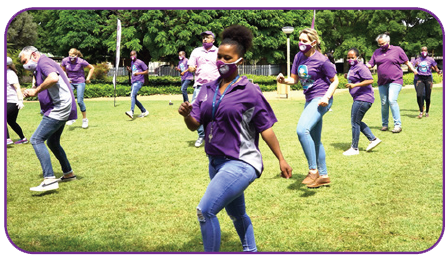
These colleagues enjoy themselves while participating in the Jerusalema dance challenge and setting the scene for sharing good news stories as part of the Organisational Citizenship Behaviour Project.
Organisational culture
Organisational culture is a vital enabler of our strategy to transform and position the university as a unitary institution of superior academic excellence, with a commitment to social justice and an ethic of care.
A critical first step was to conduct a dipstick assessment among staff and students to identify the desirable and undesirable elements of the current culture, and define the desired culture. We then held so-called Culture Conversations to facilitate inputs on what changes were needed to achieve the desired culture.
The Culture Conversations saw randomly selected participants providing their lived experience of the NWU culture. Staff and students used these conversations to express their views on issues around transparency, trust and frustration, and to reflect on the identity and history of each campus, strengthening their sense of belonging.
The NWU desires to build an inclusive, enabling and welcoming environment, the vehicle for which is the NWU Way journey, involving the co-creation of desired culture and behaviour descriptors. The insights gathered during phase one of the NWU Way project are informing the next phase, shaping balanced, viable and authentic organisational values.
The NWU Culture Baseline Report was finalised in February 2020, after all the role-players had perused and given inputs into the draft document. Owing to the limitations and restrictions brought on by the COVID-19 international pandemic, phase two of the NWU Way project was put on hold.
However, in July 2020, as part of the joint venture project in developing the organisational culture of NWU staff members and students, the Organisational Citizenship Behaviour Project (OCBP) was launched. Its aim is to complement and support the establishment of the “To Be” culture of the institution (phase two of the NWU Culture Project).
The project functioned as a stocktaking exercise on how both staff members and students understand the values of the university and, more importantly, how they experience the values in their everyday lives.
The addition of the OCBP to the initial NWU Culture Change project plan sought to build hope and optimism and was used as a platform from which the NWU will encourage and demonstrate care and pacify concerns.
The OCBP informed employees which behaviours are encouraged and implored each employee to commit to do something different to make the NWU a better place for all. Employees were encouraged to show up with a different spirit and energy to enhance the values we espouse.
