The sources of our financial capital are state funding, debt and grants, as well as revenue generated through our operations and investments. We use this capital to provide services and maintain and improve our infrastructure so that we can create value for the NWU and our stakeholders.
Managing our income and spending, as expressed in our annual budget, is the key to the health and stability of our financial environment, which is a prerequisite for achieving our strategic objectives as a unitary institution of superior academic excellence.
Our staff and students are the main beneficiaries. However, we also use our building and maintenance projects to create business and jobs for people outside the university community. Furthermore, our donors and the DHET have stakes in our manufactured capital as they fund many of our projects.






Uncertainties in the higher education sector (for instance state funding), demand for organisational change (equity of resources), risks related to academic matters, compliance (for instance with building regulations), IT and operational risks.
How we weathered the Covid-19 storm
- Students in our residences
The Covid-19 pandemic brought about a whole new way of accommodating students in university residences during the various alert levels. High levels of compliance to residence protocols were demanded from students and it was through the implementation of strict compliance rules that we managed to contain the spread of the virus to the bare minimum.
Students were allowed to return to campuses and residences according to the regulations under Alert Level 3 to Alert Level 1. The majority of the residence students accepted the invitation to return under the various levels.
Management engaged extensively with the DHET and the rest of the education sector to develop a rebate formula for the residence fees based on the savings generated on the variable cost portion of the residence expenses. The rebates; ranged from 0% to 8% for an average of 5% of the residence fees for 2020.
- Safety on our campuses
A comparison of crime statistics in 2019 and 2020 indicated major decreases in crime during the lockdown associated with Covid-19.
The lockdown levels and our online learning approach meant there were very few students and staff members on or in the vicinity of our campuses who could be targeted by criminal elements. This, together with visible policing, regular patrols carried out by our Protection Services officers, and the ban on the sale of alcohol are the main reasons for the reduction of crime in 2020.
Although Covid-19 negatively impacted our progress in developing the infrastructure of the NWU, the challenges of the initial lockdown levels were overcome by implementing remote working practices, which enabled the project planning and procurement processes to continue.

all contractors and suppliers followed these.
Infrastructure development
We spent a total of R163 million from the DHET and our own funds in 2020 for capital works, macro maintenance and minor works across the university. The following table gives a spending breakdown.
| Potchefstroom Campus |
Mahikeng Campus | Vanderbijlpark Campus | Projects across campuses | Total | ||
| DHET | Funding 2015-2016 | R912 696 | R- | R912 696 | ||
| Funding 2016-2017 | R12 194 | R- | R12 194 | |||
| Student housing 2016-2017 | R- | R29 699 762 | R- | R- | R29 699 762 | |
| Student housing 2017-2018 | R536 658 | R536 658 | ||||
| Funding 2017-2018 | R166 060 | R166 060 | ||||
| Funding 2018-2021 | R1 539 504 | R7 726 089 | R2 583 970 | R18 410 156 | R30 259 718 | |
| Capital works | New | R17 914 641 | R8 308 671 | R23 768 467 | R49 991 779 | |
| Upgrade | R11 596 298 | R10 140 040 | R6 974 330 | R3 515 988 | R32 226 655 | |
| Macro maintenance | R6 462 323 | R276 164 | R5 821 833 | R4 373 082 | R16 933 402 | |
| Minor works | R1 292 134 | R900 656 | R97 532 | R2 290 322 | ||
| Total | R38 983 154 | R56 687 384 | R40 961 951 | R26 396 758 | R163 029 247 |
DHET grant funding
In 2020, the total spent from DHET grant funding from various funding cycles amounted to R61 687 088. This excluded R82 218 434 from NWU capital funding and R19 223 724 on macro and maintenance expenditure.
The NWU needs to invest in infrastructure for digital transformation, in line with our Digital Business Strategy, which is in turn aligned with the DHET's priorities. We have submitted an application for the first phase of this to the DHET.
Accommodation for our students
Student housing on and in close proximity to the three campuses consists of 41 university-owned residences and four leased accommodation facilities being operated as formal residences. Collectively, these have the capacity to accommodate 11 066 students. The staff complement of these residents includes 110 residence officers and house parents.
Through a joint initiative by the NWU, the Development Bank of Southern Africa and the DHET, we have started to build additional residences on the Mahikeng Campus to accommodate up to 1 728 more students.
By making sure our students have safe accommodation on or around our campuses, we strengthen our student value proposition (including safety and security, and conducive study spaces) and consequently, our human capital.
Complying with norms and standards
Apart from aligning residences and the associated fees, management also focuses on ensuring that all residences comply with the national policy on norms and standards for public universities in South Africa.
All new student residence developments are developed in line with approved minimum norms and standards for student housing as prescribed by the DHET. When residences are upgraded, we ensure that the changes and improvements comply with these standards.
In 2020, the Covid-19 pandemic delayed the phasing in of the minimum norms and standards at residences which do not currently comply. This work will resume in the coming year.
A refreshed student accommodation strategy is in the development stage and includes an analysis of student behaviour in relation to residences. The new target is to increase the percentage of residence places available for first-time entrant students to at least 30% of the total residence capacity.
We also made good progress with the accreditation of private student accommodation suppliers, in line with the DHET's expectation of the role that universities must play in this space.
The DHET has allowed the universities to develop their own accreditation criteria based on their unique circumstances. To this end, we have established guidelines that identify the accommodation needs and available spaces on each campus.
Construction and refurbishment
Like all other campus operations in 2020, infrastructure, design and construction projects were interrupted during 2020, resulting in project backlogs. In all, 111 calendar days were lost during the period from 26 March to 3 July 2020.
These unprecedented circumstances challenged us to explore different pathways. We prioritised and revaluated projects, ensuring that all critical projects continue and postponing others, as approved by Council.
Construction sites were opened under strict Covid-19 regulations and some projects were completed during the year.
Large projects completed during 2020
Capital projects completed in 2020 included upgrading the Mahikeng Campus library (final phase), constructing bulk services infrastructure (NWU water reticulation), developing a multipurpose facility for student social life (Rag farm) and upgrading the roof of Building A2's storage area.
Total expenditure on capital projects came to R49,9 million for new infrastructure and R32,2 million for refurbishments. Several large projects have reopened and are still in the construction phase.
Macro maintenance and smaller projects completed during 2020
Addressing deferred maintenance remained a priority for the university throughout 2020, despite the pandemic.
Macro maintenance projects included external renovations of technical facilities, (which included demolishing asbestos buildings), upgrading the roofs and ceilings of lecture halls, resurfacing rugby fields and netball and tennis courts, upgrading HT substations and installing water meters.
The total spend on macro maintenance for 2020 amounted to R16,93 million. The projects that were not attended to were carried over to 2021 for implementation.
Seven smaller projects with a combined value of R2,29 million were completed across the campuses.
Projects carried over to 2021
Due to the impact of Covid-19 on construction activities and to manage the cash flow of the university, 32 projects were carried over into 2021 and nine were rescheduled for implementation in 2022. These projects will be completed over the next two years.
Facilities strategic optimisation project
In an effort to optimise the facilities environment, a strategic project was implemented to improve business processes by integrating and aligning role players, systems and processes to support the NWU's unitary strategy.
The project was initiated in 2019 and gained good momentum in 2020 despite the challenges of social distancing and working from home. The final phase of the project is scheduled for completion in 2021.
IT infrastructure and developments
IT plays an indispensable role in the value chains of teaching and learning, research and the student life cycle, from student access to tertiary education through to continuous professional development for our graduates and others. Optimal, cutting-edge IT support is provided to all students and staff.
Here are some of the 2020 highlights:
- IT played a key role in enabling emergency remote learning, as well as work from home. Nearly all services could be accessed from anywhere. We were proud to implement virtual application environments, enabling students to have access to all their PC lab applications.
- Security was, and still is, a big concern in the work-from-home era. NWU had a ransomware attack in July 2020, but we were able to fully recover most critical services in one day and all other services in seven days.
- Many major projects are under way. Preparations to implement a brand-new student information system are currently in the request for information phase, and the first phase of the integrated work management system will be live in the first month of 2021. Robotic process automation opportunities are being evaluated. These are just a few of over 100 active IT projects.
- We continued to offer uncapped, unshaped internet services to staff and students at a speed not matched by most universities in South Africa. The NWU is one of the biggest consumers of bandwidth in the public higher education system.
Future outlook
Being able to respond to the "new normal" during 2020 raised our confidence tremendously, as did the general stability of our IT services during the pandemic.
Years of applying good principles in planning and design are now bearing fruit. It will also be much easier to focus on digital business transformation going into the future and participating to the full in the Fourth Industrial Revolution.
“Our investment in IT infrastructure, support and teaching and learning solutions will determine the NWU market share in the teaching and learning value chain, as well as in the student life experience.”

STATEMENT ON ADDITIONAL INVESTMENT IN INFRASTRUCTURE
Plans for the future
The coming year will see further renewal of the buildings and infrastructure on the three campuses.
On the Vanderbijlpark Campus, we are on track to complete the new administration building in 2021 and will then convert the existing administration building into a multi-purpose hall.
The new main road and lecture halls should also be completed in 2021 and construction will start on Psychosocial Health's new building which is planned for completion in 2022.
We are also planning a new building link between the two buildings occupied by the Faculty of Economic and Management Sciences to improve and expand the teaching and learning experiences and spaces of staff and students.
Highlights on the Mahikeng Campus will be the completion of the first phase of the new student residences and the addition of new lecture rooms to support the new way of teaching and learning. The Disability Unit will be relocated to a new space adjacent to the Campus Health Clinic and will offer a one-stop health support service to students living with disabilities.
In 2021, we plan to complete the new space for the Business School and Unit for Continuing Education, as well as the new Psychosocial Health building. Various academic departments will be relocated while their spaces are being upgraded. Construction of a new Law Clinic to serve the community is planned for the near future.
On the Potchefstroom Campus, the construction of the new laboratories for the Faculty of Education will commence in 2021, along with the extension of the Faculty of Education's library to support students' group-work activities.
The High Performance Institute (HPI), currently located in building K21, will move to building K2 which will be renovated and restructured to house the institute and other research and educational units. Biological Sciences and Geo and Spatial Sciences will also relocate to upgraded spaces.
DR BISMARK TYOBEKA
CHAIRPERSON OF COUNCIL
PROF DAN KGWADI
CHAIRPERSON OF SENATE
See how we explore, expand and evolve
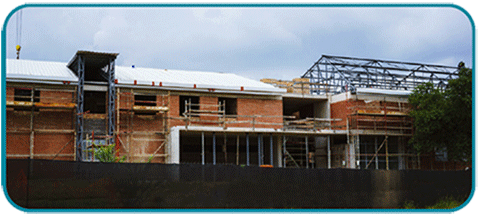
Despite the challenges posed by the Covid-19 pandemic, the NWU has moved ahead with its ambitious construction programme.
One of the new buildings being constructed is the Vanderbijlpark Campus Administration building.
"The pandemic has understandably impacted the original timeline for the delivery of the building but everybody involved has done an excellent job adjusting to the challenging working conditions," says Prof Linda Du Plessis, deputy vice-chancellor for planning and Vanderbijlpark Campus operations.
The building will house staff offices, including the deputy vice-chancellor's office, Corporate Relations and Marketing, Finance, Student Academic Life Cycle Administration and Human Resources. It will also feature event space and a 50-seat conference room.
Its many architectural highlights will include two towers facing towards the entrance, fire stairs and a beautiful lobby with artwork to welcome students, guests and staff.
Completion is scheduled for May 2021 and will be ready for occupation soon afterwards.