


As a university we appreciate that a substantial part of our success depends on the relationships we have with individuals, groups and communities outside the NWU – locally, nationally and internationally. These relationships constitute our social and relationship capital.
When our stakeholder relationships are sound, they contribute to our social licence to operate, meaning that our stakeholders broadly approve of what we do.
Effective engagement with our external stakeholders increases the value of our social and relationship capital.
External stakeholders who need to benefit from our engagement with them include the parents of our current and prospective students, communities surrounding our campuses, donors, alumni, employers, business and industry, professional bodies and the Department of Higher Education and Training (DHET).
Our relationships with external stakeholders directly or indirectly influence all our goals as a university that strives to benefit society through knowledge.
In increasing the value of our social and relationship capital, our communication, marketing and stakeholder engagement activities also fulfil an important role.

Communities surrounding our campuses may withdraw their support for work-integrated learning (WIL) or servicelearning opportunities, on which the NWU and our students are reliant, or may decline to participate in research initiatives involving community engagement.
Parents of students may be affected by the uncertainties in the higher education sector, the demand for organisational change and risks relating to student life. (Matters that may concern them include state funding, tuition fees and the safety of our campuses in the event of unrest.)
Other risks that affect our external stakeholders include risks related to academic matters, compliance and commercialisation of intellectual property.
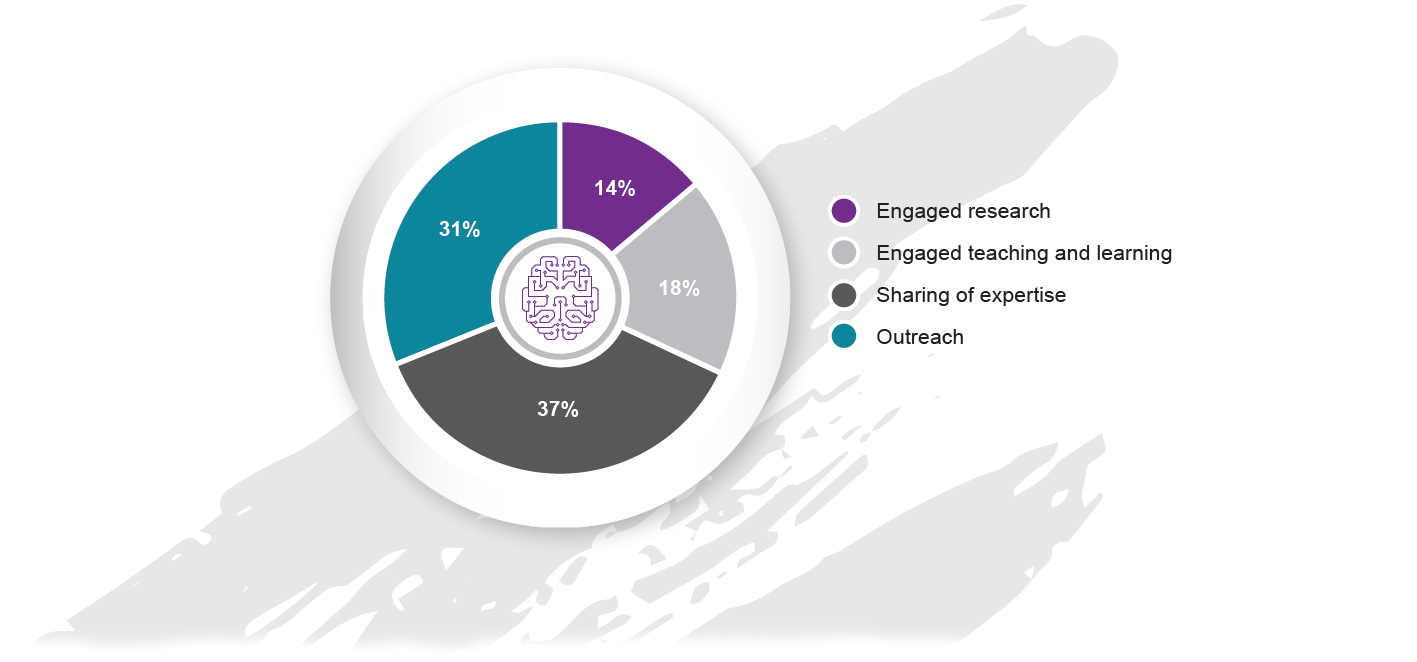
The Covid-19 pandemic caused hardship in many communities around our campuses in 2020. In response – and true to our theme, explore, expand and evolve – our staff and students undertook many innovative giving activities to assist communities. A total of 105 engagement activities were reported.
The figure below provides a breakdown of our 2020 community engagement activities:
Service learning for students is an important part of our community engagement work. Since 2019, we have been updating our database of legitimate service-learning partners for student placements by making contact with local non-governmental organisations (NGOs), public benefit organisations (PBOs) and religious organisations. We continue to make this a priority so that we can expand the number of modules that contribute to service learning in our communities and have started to expand and validate our data by calling our partners to verify their details on our database.
Click on the icons below to read more about each material matter.

 Teaching and learning;
community engagement
 Research

 Student value proposition;
develop and retain excellent staff
Community engagement is embedded in many of our teaching and learning activities, often in the form of opportunities for work-integrated learning and service learning for students; even student outreach can contribute to the acquisition of soft skills such as planning, negotiation and collaboration.
In 2020, as our responsiveness was challenged, we explored new and innovative ways of engaging with our community partners. Our activities ranged from outreach and providing food to those in need to donating personal protective equipment (PPE). We also deployed our mobile science labs to advance Covid-19 testing by the North-West Department of Health and used radio programmes to raise awareness.
As part of service learning, education students utilised social media to provide teaching assistance to teachers at schools. Commerce staff and students from the Vanderbijlpark and Potchefstroom campuses used social media platforms to provide tax tips to individuals, dealing with lockdown-related topics such as the impact of working from home on tax and travel allowances, as well as how to manage personal finances.
The NWU's law clinics and psychosocial service centres continued enabling students to integrate theory and practice while serving communities. At the Potchefstroom law clinic, staff and students saw 810 clients and attended 117 court proceedings. The law clinic in Mahikeng assisted clients with a wide range of matters, including divorces, domestic violence, children's court matters, evictions, civil claims and maintenance matters.
Given the reported increase in domestic violence during the pandemic, it was important to continue offering access to justice and legal aid to people in need.
We conduct research with, in and about communities and the real-life problems they face, thereby empowering people and improving their quality of life while increasing our social and relationship capital.
An example is the Bacha Tswelopele (Youth Taking Charge) project, which explores how a participatory action learning and action research approach can enable unemployed youth to take the initiative in making themselves and their peers more employable.
We also partnered with Gatelepele Youth Development Consultancy in Khuma to ensure the sustainability of the Youth Taking Charge project. In addition to enhancing the employability of participants, this project examined the perceptions of local youth towards unemployment.
Dr Mulunda Mwanza from the Faculty of Natural and Agricultural Sciences collaborated with the provincial Department of Agriculture to arrange activities in communities. He also secured an ambulance for use in the community and organised animal health training for emerging farmers.
Many of our researchers proactively explored innovative options to expand their contribution and evolve to break new ground in the fight against the Covid-19 scourge.
Prof Petra Bester and Prof Andrew Robinson from Health Sciences assisted the North West Province Department of Health with Covid-19 contact tracing and monitoring (surveillance), data capture, epidemiology modelling and trend analysis. Prof Hazel Mufhandu was part of the team formed to take action in the event of an increase in the infection rate.
The African Centre for Disaster Studies within the Unit for Environmental Sciences and Management has been advising the Department of Health on the declaration of a national state of disaster, the creation of the Covid-19 WhatsApp service and the drafting of the protocols for quarantine sites and lockdowns. Currently it is involved in scenario planning and is part of the department's multi-institutional Covid-19 modelling teams.
Various units within the university embarked on radio campaigns to raise awareness about Covid-19 precautions, including the Mahikeng Campus Science Centre.
See how we explore, expand and evolve
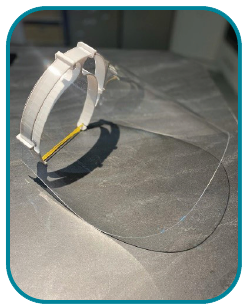
A team of NWU engineers is working on 3D printing of face masks, and has designed a ventilator that made the top three in the #ZA Ventilator Challenge.
In addition, researchers in the Faculty of Natural and Agricultural Sciences developed a viable and cost-effective assisted-breathing device.
The “ventilator” prototype was demonstrated at a gathering of officials of the North West Provincial Department of Health and stakeholders at Wes Vaal hospital in Orkney on 17 June 2020.
Encouraging our students and staff to contribute to society through volunteerism promotes the culture of citizenship that we strive to instil in all members of our NWU community.
The deputy vice-chancellor for community engagement and Mahikeng Campus operations and the deputy chairperson of the Students' Campus Council distributed food parcels and vegetables to students off campus in May 2020 in Mahikeng.
The Student RAG Community Services (SRCS) on the Potchefstroom Campus donated clothes collected in 2019 and food collected in early March 2020. Annually, more than 400 students actively participate in over 80 similar projects in the greater Potchefstroom area.
The Student Campus Council of the Mahikeng and Vanderbijlpark campuses collected food, clothing and toys and distributed these in the communities, specifically at early childhood development centres.
Challenges and future outlook
While striving to assist communities and contribute to social justice under the new normal of the pandemic, we realised the magnitude of the digital divide. Because data is expensive and not all external partners have equitable access to connectivity, the playing field is unequal and could hamper our efforts to advance social justice.
Another challenge is that the communities we work with are accustomed to face-to-face interaction, in particular when trust has to be built with new partners. It will require a "cultural reset" to build new relationships and maintain existing ones using mainly online methods.
The Covid-19 pandemic has exacerbated poverty, inequality and unemployment in many of the communities around our campuses, and amplified the obligation that institutions such as the NWU have to contribute to poverty alleviation and community capacity-building.
Our staff and students responded with agility and creativity to these challenges in 2020, bearing in mind that the range of community engagement activities available to them was severely curtailed as a result of the national disaster regulations. Amid projections that the pandemic will continue into 2021, the experience gained during the past year will be invaluable to the university and communities alike.
We also believe it would be beneficial to extend our community development footprint nationally, focusing on applied research that addresses socio-economic challenges and has sustainable impact and income generation potential. This would be in alignment with the National Development Plan and Agenda 2060 for Africa.
In adapting to the new normal, we are ready to explore new ways of building and maintaining relationships, expand our vision of community engagement and evolve our efforts to empower society.
