


As with so many other aspects of human existence in 2020, the Covid-19 pandemic highlighted how vital it is for our society to safeguard natural resources such as water. Water, healthy soil, clean air and suitable land are fundamental to the sustainable operations of the university and our ability to add value to our other capitals.
Without a healthy supply of water, the university would literally not be able to function. We use land and resources such as soil and water to construct buildings and strengthen our manufactured capital. However, by building on the land and using natural resources and creating waste during the construction process, we decrease the value of our natural capital.
All our stakeholders need natural capital to exist and flourish.
We will not be able to realise any of our goals or implement our enablers without natural resources as input.
The material matter “to promote sustainability” (part of goal three in our Annual Performance Plan) is particularly relevant here.

Risks include those related to academic and operational matters, student life, compliance (for instance with environmental regulations) and IT (infrastructure needs an energy source).
We are committed to reducing the environmental footprint of our activities by using natural sources responsibly, decreasing our energy use and complying with environmental regulations. These are part of the draft strategy and policy we have compiled and will share with our stakeholders in 2021.
As our campuses were not operating as usual in 2020, our use of resources such as energy and water were considerably lower than in previous years, which has arguably had a positive effect on our environmental footprint. Depending on how universities resume operations in 2021, this could be a temporary or more lasting scenario that will have to be taken into account in our environmental impact strategy and measurement processes going forward.
Click on the icons below to read more about each material matter.
Promoting sustainability
 Student value proposition
This section focuses on the environment as an important element of sustainability. (For information about general sustainability at the NWU, see the Council statement on sustainability.)
Environmental audit
For the past six years, since conducting an institution-wide environmental audit, we have been systematically correcting the non-compliance issues found.
This work was interrupted in 2020 as a result of the pandemic, when most of our staff worked remotely and very limited on-campus resources were available. We expect that compliance-related work will resume, to some extent at least, during 2021, although this will depend on the conditions under which the university is allowed to operate.
The different role players identified in the initial environmental compliance audit are still responsible for finalising outstanding compliance issues.
Yet again, the disruptive effect of the Covid-19 pandemic was felt. The various Green Campus initiatives that were up and running to save energy and water, to encourage recycling and to raise awareness of environmental sustainability had to be put on hold. With no students living in the residences, the annual energy-saving competition was postponed.
One area where we made progress is in incorporating environmental sustainability issues into the curriculum. Several existing modules contribute substantially to student environmental training, such as those on environmental philosophy and marine spatial planning, which cover issues such as marine pollution, microplastics and fishing pollution. Third-year tourism management students undertake eco-tourism recycling projects.
All final-year engineering students take a course that has significant environmental content. Research contributions from engineering included a project on the reduction of organic fraction of municipal solid waste. This entails using solid waste and sewage sludge to produce solid and liquid fuel products, bio-adsorbents and biochemicals.
An important contributor to environmental sustainability scholarship and research is the South African Research Chair (SARChI) in Cities, Law and Environmental Sustainability (CLES) in the Faculty of Law. The chair is part of the SARChI Initiative of the National Research Foundation and focuses on legal scholarship and research skills development for sustainable urban development in South Africa, the broader African region and beyond.
See how we explore, expand and evolve
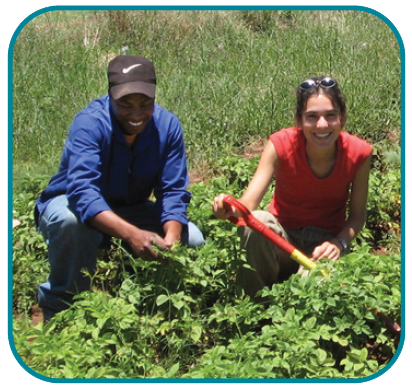
The e-Agro-Tourism CoLab funds e-agriculture skills within communities in the North West Province and runs a food security project at various schools.
The CoLab is funded by the National Electronic Media Institute of South Africa (NEMISA) and assists schools to start their own vegetable gardens and gain environmental insights.
The schools that benefit from this outreach are Lokaleng, Signal Hill, Ramosadi, Seetsele, Lotlamoreng and Podile primary schools.
With more than seven billion people relying on earth’s natural resources, it is more important than ever to explore novel ways to find sustainability solutions, expand our contributions aimed at protecting earth’s natural resources and evolve in the way we see and use them.
Challenges
It is clear that the NWU has limited specialised expertise in environmental remediation and sustainability matters.
We took steps to begin correcting this in late 2019, when we prepared a draft strategy and policy guideline on environmental responsibility. This was submitted for consultation with all stakeholders in December 2019. Currently no progress can be reported on this matter.
Future outlook
We have benchmarked ourselves against other universities to determine proper placement of the environmental management office. Indications are that this office should be part of the Facilities department.
As a starting point towards establishing an environmental management office, we are considering appointing an environmental expert who will be responsible for coordinating environmental issues at the university.
The Sustainability and Community Impact Office will continue with awareness creation, for instance by developing posters highlighting different aspects of sustainability such as littering, water and electricity usage.
As students and staff return to our campuses, we will be able to resume activities such as the Flip-the-Switch campaign launched in March 2019 to highlight energy consumption and the impact it has on the environment.
Due to the Covid-19 pandemic, there were fewer people on our campuses in 2020, and consequently the challenge of litter was considerably reduced. As students and staff return to our campuses, we will place more bins on our campuses to separate waste. We also intend to utilise the separation-at-source model for a variety of consumables that are normally treated as general waste.
Some of our other future plans include encouraging the habit of using jugs and water glasses instead of plastic water bottles at campus meetings, and encouraging our campuses to celebrate important days such as Arbor Day on 1 September.
