


 Download in another language
Governance: Supporting and preserving value

STATEMENT ON GOVERNANCE
“The NWU is committed to the principles of discipline, transparency, independence, accountability, responsibility, fairness and social responsibility, as advocated in the King IV Report.
“Accordingly, Council endorses the Code of Practices and Conduct and the Code of Ethical Behaviour and Practice as set out in King IV, and has applied these in a rigorous way during the period under review. In supporting these codes, Council recognises the need to conduct the business of the NWU with integrity and in accordance with generally accepted good practices.
“The monitoring of the NWU’s compliance with these codes forms part of the mandate of the Audit, Risk and Compliance Committee.
“A distinct difference exists in the roles and responsibilities of the chairperson of Council and that of the vice-chancellor.”Statement approval obtained from the NWU Council on 17 June 2021
The role and function of Council and its committees
As the overall custodian of good corporate governance, the NWU Council takes its oversight and guidance role seriously. We carry out this responsibility by setting strategy, ensuring proper governance, driving compliance and risk management and monitoring the material activities of the university. The intention is to provide a sound foundation for the creation of value, long-term growth and sustainability.
We act in strict accordance with the stipulations of the Higher Education Act and the NWU Statute, which was reviewed and published on 8 May 2020.
For the period under review, under Council's leadership, the NWU continued to adhere to high governance standards, while creating a value-driven governance landscape.
The composition of our Council accords with the guidelines provided by the Higher Education Act and the university's Statute.
Of the 30 Council members, 60% are external and 40% internal, ensuring independence in the governance environment.
| Council members externally elected or designated | Council members internally elected or designated | ||
| Ministerial appointees | 5 | Management: vice-chancellor and vice-principal | 2 |
| Donors | 3 | Senate | 3 |
| Convocation | 4 | Academic staff | 2 |
| Community leaders | 3 | Support staff | 2 |
| Specific expertise | 3 | Student Representative Council | 3 |
| Total | 18 | 12 | |
To ensure proper oversight and proper accountability, Council has a number of committees to advise it on all the relevant governance matters

- Assets Committee
- Tender Committee
- Investments Committee
A number of the committees meet twice a year and report to Council twice a year. The remaining committees that meet more often are the Executive Committee of Council, the Audit, Risk and Compliance Committee, the Remuneration Committee, the Transformation Oversight Committee, Tender Committee, the Investment Committee and the Technology and Information Governance Committee.
| The following new members joined the Council during the year under review: | |
|
Appointed by Council from the ranks of the university's community leaders |
|
Designated by the SRC |
| The following members re-joined the Council for subsequent terms: | |
|
Appointed by the Minister of Higher Education, Science and Innovation |
|
Elected by the Convocation |
|
Appointed by the Council for specific expertise |
Council training
It is Council practice to require all new members joining Council in a particular year to attend an induction workshop. The annual induction meeting took place on 27 July 2020 and covered the following four topics:
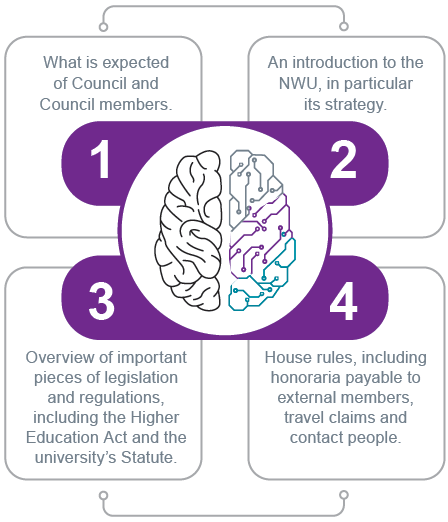
All Council members attended a workshop on 27 July 2020 that covered the following topics:
| Subject |
| Engagement with the chancellor of the NWU, Dr Anna Mokgokong |
| The NWU's Digital Business Strategy |
Engagement with the DHET covering the following topics:
|
| Self-evaluation outcome 2019 |
Code of Conduct and declarations of interest
All Council members are required to adhere to a Council Code of Conduct, which is revised as and when needed, most recently in March 2018. At the beginning of 2020, the Council members pledged their commitment to the Code by taking part in the annual signing process.
The Higher Education Act prescribes annual declarations of directorships and interests on the part of Council members. We consider this requirement to be of the utmost importance to ensure absolute integrity in our behaviour at governance level. At each ordinary meeting of the Council Exco, its members review the declarations of interest and engage on these.
Council Exco also scrutinises the transactions between the NWU and companies in which Council members declared (or did not declare) a direct or indirect interest.
At the Council meeting of 19 November 2020 it was noted that not all members of Council had fully declared their involvement in companies as was required. The chairperson subsequently requested the relevant members to do so by 30 November 2020. As at 31 December 2020, four Council members had not made the necessary declarations, and formal letters from the registrar were sent to these members to indicate this non-compliance and its consequences.
During 2020, Exco continued with the practice of regularly noting and discussing all declarations made by members of the university management committee and referring any inquiries to the vice-chancellor.
