


Our performance against our strategy: Harnessing our capitals to explore, expand and evolve
In this part of the integrated report we would like to show you how we respond to our stakeholders' needs through our business activities, and how these activities lead to outputs and outcomes, thereby transforming the value of our six capitals.
These capitals represent the value we create for ourselves and our stakeholders; our performance against them shows how we are faring in achieving our strategic goals and, consequently, evolving to become more than before.
Our intellectual capital is all about our knowledge-based intangibles that result from our core business activities: teaching and learning, research and community engagement. We will also show you how we govern and manage the university through our structures, policies, processes and systems, and how we support our core business by maintaining and further developing our information and communications technology.
Increasing our intellectual capital benefits all our stakeholders who are interested in the knowledge that we create through our research or our teaching and community engagement activities.
They include our staff, current and prospective students and their parents, the Department of Higher Education and Training (DHET), communities, donors, alumni, employers, business and industry and professional bodies.
(Click here to see what the icons used in this section stands for.)





The risks include the demand for organisational change and ongoing transformation (for instance concerning the decolonisation of the curriculum), risks related to academic matters (teaching-learning, research and innovation and academic administration), the risk of non-compliance (for instance with the standards and regulations of professional bodies), risks related to IT, university systems and commercialisation of our innovation and research results.
Click on the icons below to read more about each material matter.
Teaching and learning
Research
Govern, lead and manage
Information and communications technology
See how we explore, expand and evolve
During 2020, we used remote learning, which includes online and distance learning, to continue our academic activities.
"Our priority throughout the Covid-19 crisis has been to support students to continue their studies through the modalities best suited to these extraordinary circumstances," says Prof Robert Balfour, deputy vice-chancellor for teaching and learning.
"Similarly, when it comes to our staff, the university's planning efforts have focused on keeping them safe and empowering business continuity from their home environments."

In realising our commitment to foster academic success, we emphasise the quality and diversity of teaching and learning activities and readily invest in staff development and student support and development. We also align our academic programmes across the university, ensure they are evaluated regularly and expand the reach of our distance learning offerings through appropriate ICT and multimedia resources.
Increase student access and success
Extensive, value-adding academic support is offered to students, as discussed in the following section.

Extended curriculum programmes
In a number of natural sciences and economic sciences programmes, students can complete their studies over an extended period of time. The value of these programmes is evident from their overall student success rate of approximately 90%.
In 2020, we had 1 275 first-time entering students on extended programmes and a total enrolment of 4 404 students. By the end of 2020, some 15% of this group of students had graduated.
University Preparatory Programme (UnivPrep)
UnivPrep is a one-year short learning programme that enhances access to specific degree programmes at the NWU. Each year, approximately 45% of successful UnivPrep participants become eligible to apply for formal degree studies.
Academic literacy tests and modules
An academic literacy test is compulsory for all first-year students, who may then be required to register for specific academic literacy modules in academic writing, reading, computer and information literacy and study skills.
Incorporating discipline-specific content where possible, these modules allow seamless integration of contact and multimodal offerings, as well as a greater focus on self-directed learning. It was noted, with concern, that students struggled with self-directed learning, particularly the weaker students who are in need of greater in-person support.
Tutorial programmes 2020
Together with the other student support programmes, appointing tutors enabled us to maintain a good contact success rate of 90%. (To read more about our student success rate, click here.)
Supplemental instruction
During 2020, Supplemental Instruction (SI) was offered in an online modality for the first time due to Covid-19. Targeted at historically difficult (at-risk) modules, it supports undergraduate students within these modules through regularly scheduled small-group sessions by trained SI facilitators.
SI was offered in 455 modules across the three campuses in 2020. In the first semester, 453 SI leaders were appointed and 318 SI leaders in the second semester. A total of 22 648 students attended the more than 17 706 sessions during the year.
Academic peer mentors
In the academic peer mentoring programme, high-performing senior students support first-year students to adapt to university life. Despite the challenges resulting from the
Covid-19 pandemic, the 74 academic peer mentors recorded 5 052 interactions with 3 285 student mentees in their first year at the NWU.
Taking the contact offering into the online environment during the Covid-19 crisis
In response to stringent national lockdown measures, our faculties developed contingency plans to deal effectively with teaching and learning and continuous assessment while adhering to the General Academic Rules and specific Faculty Rules.
Our lecturers did not hesitate to explore new pathways, expand their horizons and evolve their skill sets. They embraced appropriate technologies and online methodologies to enable the continuation of quality teaching and learning. In exceptional cases where connectivity issues hampered participation in the online programme, printed material was provided.
From the start, we focused on mobile-friendly, low-tech, low-data and low-immediacy teaching. This approach was intended to enhance the chances of every student engaging with lecturers and with their study materials, and completing online assessments successfully.
Students who needed printed materials to complete their studies received comprehensive information packs and additional guidance for every module.
The NWU launched a project to provide students in need with data and devices, while faculties established special call centres to communicate with students and Library and Information Services came to the table with virtual library and information services. The Centre for Teaching and Learning made sure that staff and students had optimal virtual support to teach and learn in an online environment.
See how we explore, expand and evolve
As with all things new, the NWU community has had to address the many challenges associated with technical and other difficulties by exploring new possibilities, expanding our view and evolving in how we do things.
During the pandemic, the Centre for Teaching and Learning (CTL), for instance, has implemented various channels to reach out to lecturers.
They offer comprehensive support for staff needing to use electronic media to facilitate learning online or teach via the distance modality. This support has included webinars, telephonic and video assistance, as well as print material.
2020 will be remembered as a year during which all staff and students were required to think differently, act differently and interact differently – and succeeded in doing so.
Student success rate
As indicated earlier, we maintained a good contact success rate of 90%.
Our 2020 contact undergraduate graduation duration factor was 1,12, improving slightly from the 1,13 of 2019. This can be attributed to enhanced strategies for student support, early identification of at-risk students and NSFAS funding with provision for books and accommodation.
How much value we created, compared to previous years
| Academic performance | 2017 | 2018 | 2019 | 2020 |
| Contact student success rate | 86% | 85% | 85% | 90% |
| Contact undergraduate, graduation duration factor | 1,15 | 1,13 | 1,13 | 1,12 |
| Graduation rate | 25,6% | 25,1% | 23,5% | 27% |
How much value we created, compared to our targets
| Academic performance | Target | Definition | Actual |
| Contact student success rate | 85% | Based on HEMIS data. Completed FTE's divided by enrolled FTE's on a module level. | 90% |
| Contact undergraduate, graduation duration factor |
1,2 | Based on HEMIS data. The time (in years) it takes a student to graduate divided by the minimum time of the qualification. | 1,12 |
Students across our campuses should all benefit from comparable high-quality teaching and learning, and have access to equivalent resources. It is important that academic programmes are sustainable and always relevant, so that all graduates have an equal opportunity to find work or to develop into entrepreneurs who create jobs for others.
Ensure high-quality academic programmes
In 2020, three major NWU programmes were externally evaluated for quality assurance: BSc Agriculture (agricultural economics), Postgraduate Diploma (nuclear science and technology) and the Bachelor of Theology (pastoral counselling and psychology).
No professional or statutory body evaluations/reviews were conducted in any faculties because of the Covid-19 pandemic.
A number of internal programme reviews were conducted virtually at the faculties of Humanities and Theology. The NWU National Doctoral Review took place in the second semester of 2020, and the report is expected in early 2021.
Contingency plan for Emergency Remote Teaching and Learning Task Team
In another example of how the NWU community lived the theme of this integrated report, namely to explore, expand and evolve, the CTL was instrumental in developing the strategy for emergency remote teaching and learning.
A comprehensive keep-on-teaching webpage was prepared and a task team generated information on students' data access, connectivity and technology access. All information about emergency remote teaching and learning was centrally coordinated and communicated via a single channel and portal.
Learning design
Owing to the pandemic, there was a need to redesign modules and study materials while migrating to the online environment.
Through webinars, one-on-one virtual consultations and general drop-in rooms, we assisted lecturers to execute the so-called "LOW strategy". This refers to the combination of low bandwidth, low connectivity, low technology, low data and low immediacy characteristics that comprised our online strategy, which was also mobile friendly and based on eFundi, our learning management system.
Lecturers also received support in the design and development of paper-based study materials for students without access to connectivity, data and technology.
Digital Teaching and Learning Environment (DTLE)
Our eFundi infrastructure was upgraded to support the explosion in digital traffic in 2020. This entailed increasing the number of servers from 10 to 20. We also launched a proof-of-concept project to expand the footprint of Panopto, a digital platform used for the uploading and downloading of video materials, as part of the broader integrated video strategy.
Other important DTLE projects entailed completing an on-screen PDF marking system and implementing a call centre and service management system to deal with the sudden increase in service requests to the eFundi help desk.
Work-integrated (WIL) and service learning system established
The development of a centralised system for WIL and Service Learning started in 2019 and continued into 2020. Its primary client during this time has been the Faculty of Education, which requested the new system for its teacher trainee placements.
Although WIL placements could not go ahead owing to the outbreak of the pandemic, system development proceeded and from June 2020, was expanded to include the WIL modules of the schools of Nursing and of Pharmacy in the Faculty of Health Sciences.
Expand distance learning
We expanded our academic offering via distance learning in 2020. We received SAQA registration for the PGDip in industrial engineering, Bachelor of Theology Honours in theology, AdvDip in IP mathematics education, AdvDip in education management and leadership and PGDip in special needs education. (PGDiP stands for postgraduate diploma.)
The AdvDip in intermediate phase mathematics education received accreditation, with NQF registration pending. Further development to our distance offering includes PQM clearance for the AdvDip in foundation phase education, AdvDip in intermediate phase education, AdvDip in FET phase education and BEdHons in early childhood development.
Our output: graduates
The number of graduates is much lower than planned due to the drop in distance enrolments.
How much value we created, compared to previous years
| Graduates | 2017 | 2018 | 2019 | 2020 |
| Overall | 16 004 | 15 350 | 14 961 | 15 454 |
| Contact | 9 931 | 10 650 | 11 191 | 11 697 |
| Distance | 6 073 | 4 700 | 3 770 | 3 757 |
How much value we created, compared to our targets
| Output | Target | Definition | Actual |
| Graduates | 15 743 | Based on HEMIS data; number of graduates in reporting year. | 15 454 |
This is how our graduation rates (for undergraduate students) compare to other South African higher education institutions:
NWU graduation rate for students in 2020: 27%
(The national average for 2019 was 20,6%.)
Challenges in teaching and learning
Critical teaching and learning priorities had to be managed despite the pandemic. A number of these included the further decolonisation of the curriculum, the Africanisation of appropriate sections of our offerings and creating opportunities to promote multilingualism in teaching and learning spaces. At any given time, the NWU must also ensure that all our offerings are nationally and internationally comparable and appropriately designed and incorporate accessible ICT to address teaching and learning challenges such as those associated with Covid-19.
The pandemic compelled us to attend to several key teaching and learning issues, expanding the way we think about our activities. Issues receiving attention were the development of the emergency remote teaching and learning strategy, eAssessment platforms and the 21 Futures task team (responsible for addressing capacity and spatial challenges associated with Covid-19 protocol adherence going into 2021).
Future outlook
In 2021 we will pursue the further establishment of a Centre for Higher Education Development, and the professionalisation of university teaching at the NWU through the development of a postgraduate diploma in higher education. Also planned for the year is a strong focus on language, race and gender as key themes for cross-curricular, online engagement between academics and students.
The finalisation of our digital business strategy will be a key pillar of the unfolding teaching and learning journey at the NWU, and we will remain committed to helping to "transform and position the NWU as a unitary institution of superior academic excellence with a commitment to social justice". From a teaching and learning perspective, this means concentrating all our efforts on supporting student success and developing our academic and administrative staff, with a continued commitment to an ethic of care.
Our commitment to staff development, student support, research, and teaching and learning excellence remains firm. In 2020, we gained immense learning and understanding about how to operate effectively during a national (health) disaster. We can now build on this advantage by approaching 2021 with a spirit of hope and optimism, careful to curtail risks to our communities and determined to overcome the impact of isolation, fear and anxiety associated with Covid-19.
Even within an ethos of Covid compliance, we will strive to enhance our ethos of care to not only minimise the risk to lives but also enhance the sustainability of the NWU as an academic community devoted to social justice and committed to excellence.
“Our theme in 2020 as university was one of consolidation, in terms of the operational model and systems, but in fact it turned out to be a year of accelerated change and responsiveness.”
Our researchers and inventors strive to find affordable, workable solutions to real-life problems. Through their cutting-edge research and innovation activities, we increase our intellectual capital and create value for ourselves and our stakeholders.
Our researchers and innovators embarked on a journey like never before to explore, expand and evolve. They did this in a concerted effort to help society overcome the challenges the pandemic posed – they designed face masks, built or adapted respirators, developed Covid-19 screening apps and helped the North West province prepare for the pandemic.
See how we explore, expand and evolve
Chop-chop. This is how quickly the smartphone app - aptly dubbed "TjopTjop" – can solve congestion problems at school gates caused by mandatory health screening of learners.
What's more, this digital health-screening kit and brainchild of the Faculty of Engineering has won a United Nations Economic Commission for Africa innovation award. It was also a national finalist for South Africa in the World Summit Awards 2020.
The kit captures data about the identity of the learners, their temperatures and whether they are wearing masks. The data can be viewed in real time on a web portal.
Click here to read more about this award-winning invention.
Research output
NRF ratings are a key indicator of the calibre of a university's researchers. We again recorded an increase in NRF ratings, increasing from 229 in 2017 to 248 in 2019. The numbers of researchers in the different rating categories are set out in the following table.
| NRF | 2017 | 2018 | 2019 |
| A | 2 | 2 | 0 |
| B | 24 | 25 | 27 |
| C | 155 | 150 | 161 |
| P | 2 | 1 | 2 |
| Y | 46 | 54 | 58 |
| TOTAL | 229 | 232 | 248 |
Publications
How much value we created, compared to previous years
| Research | 2016 | 2017 | 2018 | 2019 |
| Publications per academic staff member | 0,92 | 0,86 | 0,94 | 0,98 |
| Weighted research output | 2 609,64 | 2 605,50 | 2 708,94 | 3 058,02 |
Increase our global standing and visibility
The NWU signed 19 formal international research and innovation collaborations in 2020, which further expanded our global presence. Of these collaborations, five were with top 500 institutions as rated by Quacquarelli Symonds.
However, it must be said that the Covid-19 pandemic adversely affected many internationalisation activities at the NWU and severely hindered the pursuit of new partnerships and collaborations. The impact of these constraints will be reflected in our reporting in 2021.
What has not changed is the calibre of our international partners. Our research collaborations, which range from joint degrees and co-chairs to collaborative research and innovation programmes, skills development and international student recruitment and exchange, involve prestigious institutions such as the Corporación Universidad de la Costa in Colombia, the University of Leeds in the United Kingdom and the University of Hong Kong in Asia.
The NWU also belongs to strategic inter-institutional collaborations such as the Southern African Regional Universities Association (SARUA), which recently signed a memorandum of understanding with the OBREAL Global Observatory. Another strategic involvement is our membership of the Southern African-Nordic Centre (SANORD), which advances strategic, multilateral academic collaboration between institutions in the Southern African and Nordic regions.
When international travel is allowed, NWU delegations visit Chinese universities as China is a research and innovation hub and both China and South Africa are part of the BRICS bloc, whose other members are Brazil, Russia and India. The NWU is an active partner in BRICS research collaborations and has knowledge and skills-sharing agreements with several BRICS universities.
Innovation and technology fuel our drive to explore, expand and evolve
The university is evolving its approach to innovation. Instead of focusing on intellectual property (IP) curation, we are shifting to the transfer or monetisation of our IP portfolio. This includes trimming the low-value or mature patents, and taking more relevant technologies to the marketplace.
Marketing the NWU's technologies is a critical step of the technology transfer process, but was affected by the cancellation of various national and international events in 2020. We have pivoted to online marketing which will intensify as the pandemic persists.
Despite a difficult year for laboratory research, NWU researchers submitted 16 new IP disclosures to the Technology Transfer and Innovation Support Office, which filed four new patent applications. Among the disclosures were digital solutions to combat the Covid-19 pandemic, namely the TjopTjopTM health screening app, a method for remote monitoring of ventilators and a system to digitally process polymerase chain reaction or PCR-based diagnostic test results.
Researchers also re-engineered existing technologies towards Covid-19 solutions. An example is the ozone generator prototype for disinfection, which was adapted from the ozone-producing method of Mr Barend Visser of Physics.
Externally, the NWU was part of the MERSETA Viro-Vent Skills Innovation project, where we worked with researchers from four other South African universities to train scientists and engineers in ventilator development and production.
The Technology Transfer and Innovation Support office again received recognition for excellence in innovation management. Innovation manager Mr Hannes Malan received the DSI/SARIMA Award for Professional Excellence in Innovation Management in 2020. This followed the DSI/SARIMA award for Early Career Excellence in Innovation Management awarded to Mr
FR Bezuidenhout, commercialisation Specialist, in 2019.
Licensing to industry, locally and internationally, is our preferred commercialisation route. In 2020, we concluded a new licence agreement for the WhartelsTM mathematics board game.
The NWU's relationships with industry and communities are vital enablers of innovation and industry-led research. Efforts to develop these relationships will continue in all earnest.
Challenges with research output
The Covid-19 pandemic has been a massive challenge for humanity but one that brought out the best in the research and innovation community globally. The NWU is privileged to have been able to contribute towards solutions to some of the societal challenges posed by the pandemic.
By the same token, the global health crisis has exacerbated existing funding constraints, adding to the already significant effort that will be needed if we are to succeed in increasing our research output.
Another pre-pandemic challenge that has been amplified is the unequal distribution of contributions made to research and innovation. About 20% of our academics deliver almost 80% of our research output, limiting our ability to increase per capita output. This showed only slight growth from 0,94 in 2019 to 0,98 in 2020. We also view the lack of sufficient incentives for our productive researchers as a challenge.
Future outlook
The societal challenges within South Africa and the continent more broadly have been exacerbated by the Covid-19 pandemic and the inequalities and shortcomings it has exposed will have to be addressed in the months and years ahead.
There is room for contributions from researchers in all disciplines, from law and education to the natural and social sciences and the economic and management sciences. It is to be hoped that those not yet participating actively in research and innovation activities will heed the call to do so. This is in their professional best interests as the requirement to contribute has been formalised through the setting of research output targets in the faculties, in consultation with the relevant academics.
The NWU is playing its part through support mechanisms such as research leave, relief from teaching at selected times, dedicated research time for each academic and the integration of research into teaching and learning activities.
At the same time, we are formulating additional strategies to encourage and guide academics who do not deliver research output, and to retain those who are active researchers.
“The university is evolving its approach to innovation. Instead of focusing on intellectual property (IP) curation, we are shifting to the transfer or monetisation of our IP portfolio. This includes trimming the low-value or mature patents, and taking more relevant technologies to the marketplace.”
See how we explore, expand and evolve
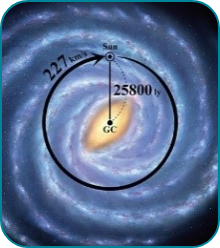
Prof James Chibueze is the only researcher from Africa who has made contributions to the finding of a Japanese radio astronomy project that the Earth is moving faster than it used to.
They also discovered that Earth is nearly 2 000 light-years closer to the black hole in the centre of the Milky Way Galaxy.
Prof Chibueze, an associate professor at the NWU's Centre for Space Research since 2019, is an avid promoter of radio astronomy and astrophysics.
He is passionate about his research. "I am excited that through this research, we are able to provide a glimpse into what our galaxy, the Milky Way, looks like and how close we are to its centre."

Our governance structures and approach to ethics, as well as our strategy, values, success model and Annual Performance Plan, guide us to ensure good governance and management.
These are part of our intellectual capital, together with the systems, processes, procedures and policies that support governance and management.
For more information about how our management activities increase our intellectual capital, refer to the report of the vice-chancellor and, for information about governance, see the section on governance supporting and protecting value.
The expectation is that a willingness to adapt to changing circumstances, explore new possibilities, expand our way of thinking and evolve in how we do things, might be a key contributor to realising strategies in future.
If there is one field in which our theme, explore, expand and evolve, came to the fore during 2020, it was in information and communications technology (ICT).
As a 21st century university, the NWU uses ICT and digital resources for all aspects of its core business, as well as support services.
ICT affects two of our capitals: intellectual capital, such as software programs, IT support services and the e-learning system eFundi, and manufactured capital, comprising the networks and hardware that make up our physical ICT infrastructure.
The Information Technology (IT) department is responsible for enabling most of the university's technological capabilities and has comprehensive product, project and services portfolios.
Utilisation of IT products within the university community has been growing exponentially, an example being eFundi, our primary learning platform. The following image shows how activity on eFundi has escalated since 2018.
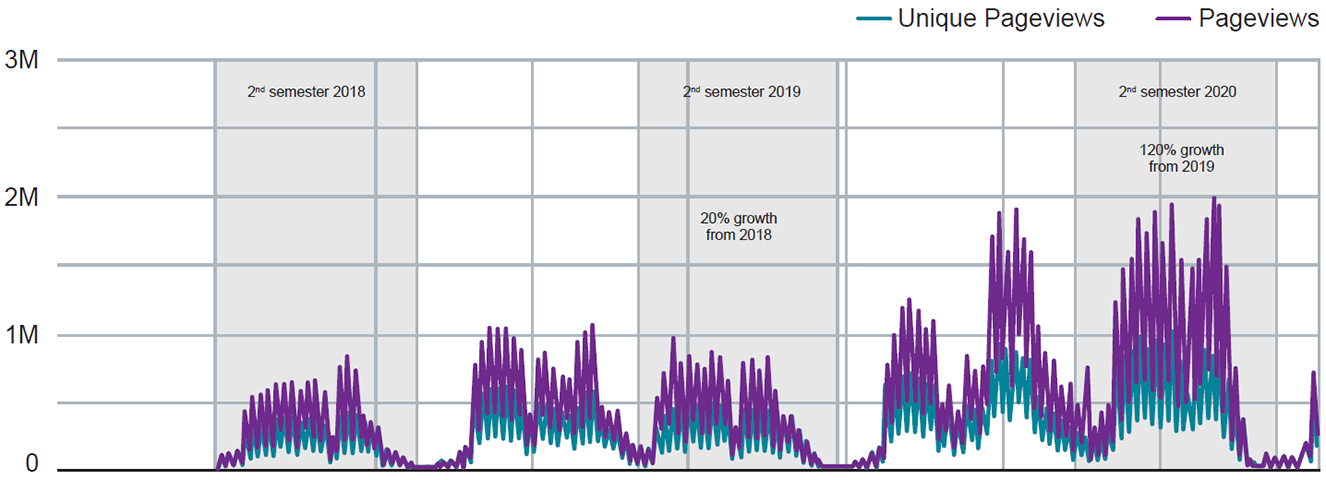
Since starting with online learning in 2020, the number of students using eFundi daily has at least doubled. Approximately 45 terabytes of traffic have been flowing to and from eFundi each month and lecturers have loaded about three terabytes of content on the system since the lockdown started.
Another factor that impacted our systems in 2020 was the huge increase in online meetings. During the first 16 days of lockdown in 2020, 5 470 connections were made on Vidyo, compared to 4 943 in the last sixth months of 2019. This does not include connections made via other virtual platforms such as Microsoft Teams, Google Hangouts, Zoom and Big Blue Button.
The IT team also developed a Covid-19 pre-screening app with questions that staff members have to answer before gaining access to the campuses.
We expect that the usage of our IT products will continue to grow strongly as the university moves deeper into the digital era.
In our 2020 Performance Assessment Report, you can see how we performed against key performance indicators (KPIs) linked to the goals in our Annual Performance Plan. By comparing the actual figures for 2019 and 2020, we could assess how well we had done against our targets.

STATEMENT ON INFORMATION TECHNOLOGY
“Covid-19 accelerated the NWU’s digital journey and we will not go into reverse now. We have learned that digital transformation will touch business models, culture, clients, operating models and technology. NOW is the time to put the foot on the accelerator and not on the brake.”
– Boeta Pretorius, director of Information Technology
